You can find reliable metal stamping suppliers in China through B2B sourcing platforms, industry trade shows, peer referrals, and specialized sourcing agents. China is the world's largest metal stamping country and makes up about 32% of global metal stamping market revenue, so there are many suppliers to choose from. Finding a supplier is easy. Proving that a supplier deserves your business is the real work. This guide shows you what reliability looks like, where to look for candidates, and how to check each one before you commit to tooling or volume production.
Look for five key signs of a reliable supplier: engineering support, process coverage, quality systems, clear communication, and the ability to scale.
Find suppliers by using online platforms, trade shows, referrals from peers, and sourcing agents.
Check every supplier using matched quotes, sample parts, first-article reports, factory audits, and certification checks.
Make sure the supplier's tolerances, how much they can produce, and their industry experience fit what your project needs.
Begin with a small test order to check the supplier's full ability before you commit to large amounts.
Reliability in metal stamping comes down to five things: engineering support, process coverage, quality systems, communication, and the ability to scale from prototype to volume. You can check each one before you place an order.
A reliable metal stamping supplier gives you design feedback before anyone cuts steel. This is called design for manufacturability, or DFM. The supplier checks your part shape, material choice, tolerances, and forming sequence, then points out problems early. Good DFM reviews catch tight bend radii, awkward hole placement, and features that need extra forming steps. Fixing these issues at the drawing stage costs much less than fixing them after tooling is built.
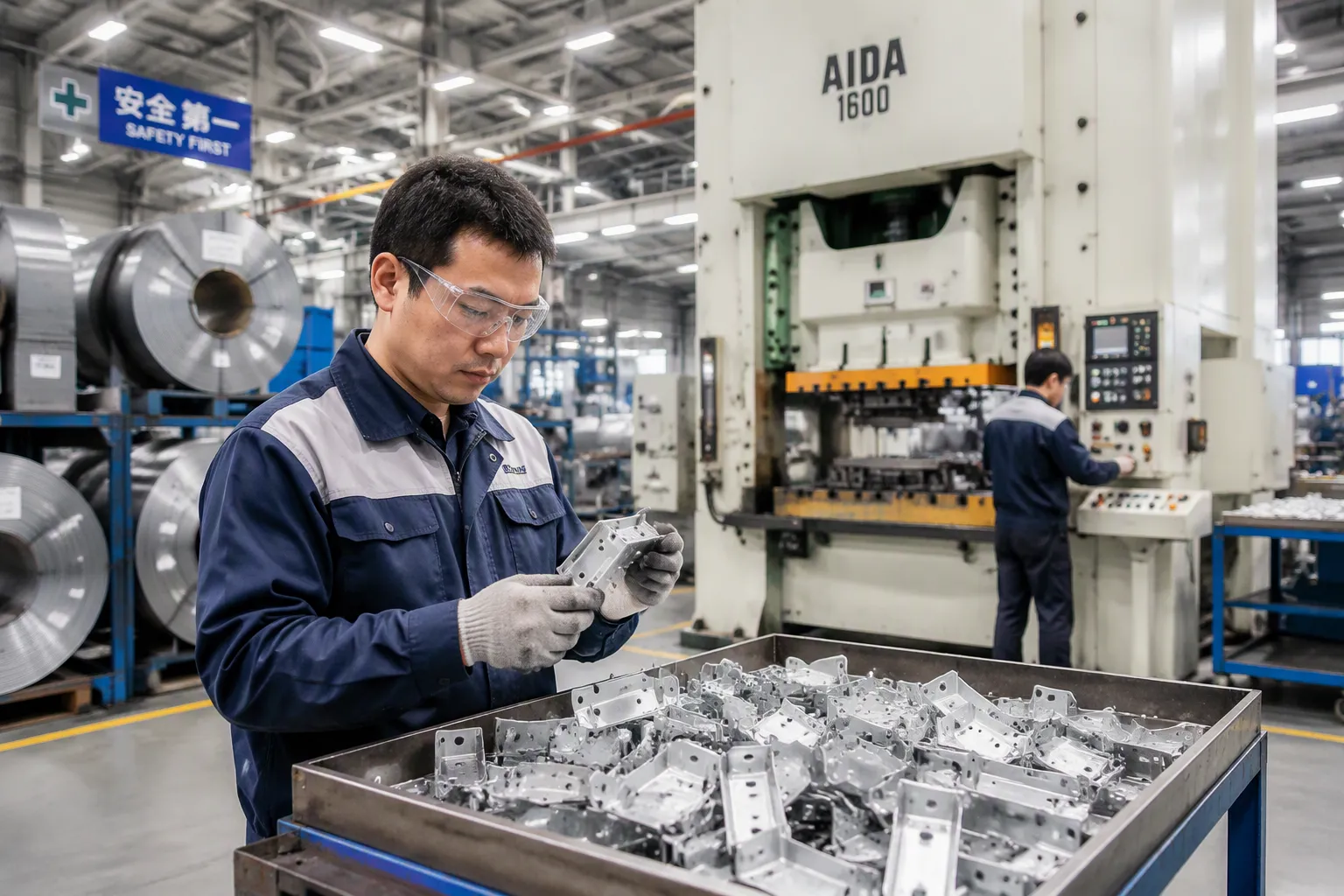
Process coverage matters just as much. Ask whether the manufacturer does progressive die stamping, blanking, and forming in-house, and whether it designs and builds its own dies. In-house tool and die work protects your tooling investment and speeds up adjustments. A dependable metal stamping services partner also offers prototyping and a clear path to full production.
Engineering Support Capability | What It Means for You |
|---|---|
DFM review | Design issues surface before tooling costs begin |
In-house tool and die design | Faster repairs, tighter tolerances, clear accountability |
Early quality checks | Problems are caught before production starts |
Production capacity | Your volume forecast fits their floor space |
Quality systems give you proof, not promises. Look for ISO 9001:2015 certification, and ask for the scope of that certificate rather than the logo alone. Automotive work often calls for IATF 16949. A reliable stamping supplier also provides first-article inspection reports and in-process inspection data for stamped metal parts.
Communication is the signal buyers overlook. Ask one question: is technical communication clear and responsive? A supplier that answers tolerance questions with vague language will struggle later. Strong metal stamping manufacturers reply quickly, use bilingual staff or translators, and share drawings and inspection data through cloud tools. These habits keep quality control visible across time zones. Reliable metal stamping services in China depend on this kind of clarity, and so does your schedule.
You now know what reliability looks like. The next step is finding candidates worth checking. Four channels do most of the work: online platforms, trade shows, referrals, and sourcing agents. Each one fits a different situation.
B2B marketplaces give you the fastest way to reach a large pool of factories. Haizol runs a managed marketplace for custom parts. It links more than 300,000 sourcing professionals with over 800,000 manufacturers across Asia. You upload a CAD file to its Metal Stamping China service page and get quotes from verified fabricators within 24 hours. The platform uses an AI-powered supplier matching engine, and supplier profiles show factory size, press tonnage, monthly capacity, workforce, and certifications. Its directory also splits stamping into die stamping, deep draw stamping, fine blanking, and CNC punching.
Alibaba and Global Sources offer far more listings, and verification badges there carry different trust levels. One UK buyer noted that Alibaba sends a single request to relevant approved suppliers. A Reddit user reported the opposite experience: some respondents contacted him off-platform, and one admitted to being a trading company rather than a factory. Treat every listing as a lead, not an endorsement. A few examples show the range of profiles you will see:
Company | Location | Reported Employees | Relevance |
|---|---|---|---|
FST Metals Co., Limited | Dongguan, China | 11-50 | Precision sheet metal fabrication |
First Part Limited | Zhongshan, China | 201-500 | Digital manufacturing, prototyping, low-volume and mass production |
Alumess Group | Ningbo, China | 51-200 | High-quality solutions across industries |
Trade shows let you see stamped metal parts in person and judge a factory's capabilities face to face. The Canton Fair in Guangzhou runs three phases each spring and autumn. Phase 1, held 15–19 April and 15–19 October, covers machinery and metalworking equipment, which makes it the right window for your sourcing trip. Industry-specific expos go deeper. CIMES in Beijing focuses on metal cutting and CNC tools. CIIF in Shanghai hosts Metalworking and CNC Machine Tool alongside MWCS, which covers metal forming, lasers, and measurement. CMES Dongguan displays sheet-metal and stamping systems, and ITES Shenzhen targets precision manufacturing. A show visit costs more time than a platform search, yet it gives you samples, press demonstrations, and direct conversation with engineers.
Platforms win on speed and volume. Shows win on verification depth. Many buyers use both: shortlist online, then meet the finalists at an exhibition.
Referrals often turn up checked options faster than any platform search. Industry associations publish member lists with company profiles. Regional export associations also check smaller workshops that never show up in national directories. Existing suppliers and industry peers give the most honest recommendations, because their reputation sits behind the introduction.
Benefits of Peer Referrals | Limitations of Peer Referrals |
|---|---|
Association directories provide pre-screened supplier pools and verified business registration | Membership confirms legal registration, not performance or delivery reliability |
Trade events give physical access to meet stamping suppliers and inspect sample parts | A logo on a website does not prove current membership |
Networks reveal district-level industrial cluster workshops | Directory listings confirm legitimacy, not capability |
A metal-forming company founder describes how peer networking proved integral to his success: an experienced peer advised him to "become active in your new industry's association — don't just join and be passive." Later, while negotiating to take over a competitor's stamping operation, a peer group member urged him to move the equipment into his shop before the contract was signed. He followed the advice, negotiations went smoothly, and "twenty five years and billions of pieces later, they are still our largest customer."
Once you build a shortlist of 5–10 candidates, ask each one for four items:
An equipment list.
ISO 9001 certification.
Industry references.
A sample inspection report.
Drop any supplier that cannot produce these documents within 48 hours.
A sourcing agent shortlists factories, compares quotations, coordinates samples and inspections, and supports factory visits. This china sourcing route suits first-time buyers and complex projects with multiple parts or factories. Agents add local presence and convenience, yet they add cost. Neither channel is inherently better.
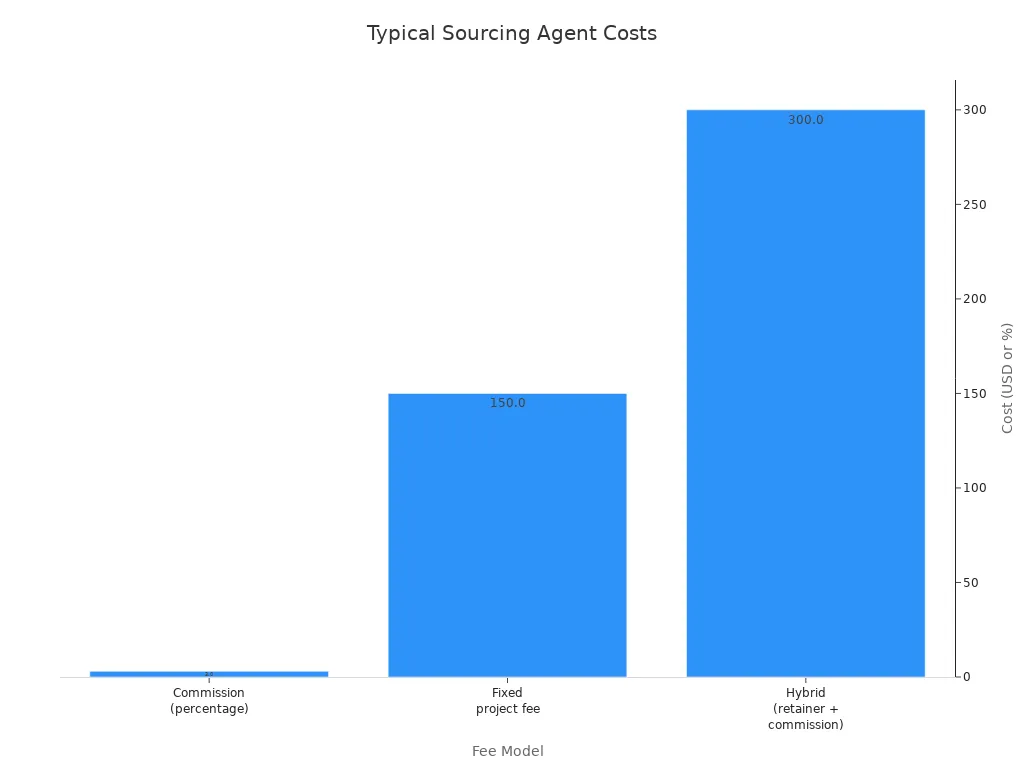
Commission models charge a percentage of order value, fixed project fees price each SKU or project, and hybrid retainers combine a monthly fee with a reduced commission. Ask your agent to verify certificate scope, request live SPC charts, and require Cpk studies on critical dimensions. That discipline turns sourcing into a verified process, not a gamble.
You have a shortlist. Now you need proof. Run every candidate through the same steps, so you compare them fairly.
Start by making every quote match one drawing revision, one material spec, and one yearly volume. Ask each supplier to list tooling, piece price, secondary operations, inspection, packaging, and logistics as separate costs. Request cost per piece at several volumes, like 5,000, 10,000, and 20,000 units, so tooling cost is spread across the program. A much lower quote usually means different assumptions — a simpler die, fewer stations, or checks pushed to final inspection — not better efficiency. Make those differences clear now, not after the deposit.
Then follow a clear path:
Send the RFQ and review each DFM response.
Clarify technical points and approve the tooling proposal.
Build the tool and run a first article inspection.
Move to pilot production and review process capability.
Grant production approval.
Treat the first article as one data point, not final proof. It shows the tool can make a conforming part under one set of conditions. Ask for the ballooned drawing, measured values against nominal and limits, material mill certificates, gauge calibration records, and any nonconformance disposition. Then request pilot data on critical dimensions, burr development, and tool wear. A reliable metal stamping supplier welcomes this close look.
Pull the ISO 9001 certificate as a PDF and read the scope statement. ISO 9001 is process-agnostic, so a valid certificate can cover only trading or administrative services. The scope must name metal stamping, progressive die stamping, or sheet metal fabrication. Match the certificate address to the plant that will actually run your parts. If the supplier designs your dies, confirm Clause 8.3 is not excluded. Check the certificate number on the issuing body's register or the IAF CertSearch database.
Check | Red Flag If… |
|---|---|
Scope keywords | Vague text like "manufacturing of products" |
Site address | Only a headquarters or PO Box listed |
Status | Suspended, expired, or unverifiable |
Accreditation logo | No AB logo, only an ISO mark |
Book a factory audit with a set list of claims to check. Walk the floor from coil storage through the press line, secondary operations, and final inspection. Confirm in-house tooling capability, and ask whether plating or heat treatment is subcontracted. For incoming goods, sample per ANSI/ASQ Z1.4 at pre-shipment. Ask for two or three references and call them.
Watch for red flags throughout. Vague answers on tolerances, no sample policy, reluctance to share certificate scope, quotes below raw-material cost, and payment requests to a personal account all signal risk. Any one of them deserves a direct question before you commit. These checks separate a genuine china metal stamping manufacturer from a trading company with a catalog.
The best metal stamping manufacturer in china for your program depends on four things: tolerance requirements, yearly volume, tooling investment, and industry. First, separate critical features from non-critical ones. Mark the features that control assembly fit, sealing, or function as Critical to Quality. Allow looser tolerances on clearance edges and body profiles. Vary tolerances by feature type instead of applying one uniform block across the print. Formed angles and bend heights can carry wider allowances than flat pierced holes.
Tolerance Requirement | Manufacturing Impact |
|---|---|
Standard tolerances | Normal tooling and inspection requirements |
Tight dimensional tolerances | Higher tooling precision and process control |
Critical GD&T requirements | Additional fixture and measurement requirements |
Excessively tight tolerances | Increased cost without functional benefit |
General linear dimensions on custom stamped metal parts commonly hold to roughly ±0.05 mm to ±0.10 mm under suitable geometry, material, and process conditions. Treat that range as production experience, not a guarantee. Standards such as ISO 2768 and ASME Y14.5 define frameworks, not achievable stamping capability. Submit early drawings for a DFM review before tooling release, so tool engineers can flag features worth relaxing.
Volume decides the process. Progressive die stamping suits complex shapes and high-volume repeatability, while other processes fit low-volume or prototype work.
Annual Volume | Process Suitability |
|---|---|
Below ~50,000 units/year | Progressive die questionable |
~50,000 units/year | Progressive die break-even |
50,000 → 500,000 units/year | Progressive die economical |
A low-to-mid-volume stamping provider says it can handle anything from a single prototype up to runs of 10,000+ pieces annually.
Industry fit sharpens the choice. EV work demands tight tolerances for battery, sensor, and power integration. Precision rail stamping often requires tolerances as tight as ±0.0005" on critical dimensions. Electronics and high-voltage motor parts sit between these poles.
Hehua Machinery Technology (Kunshan) Co., Ltd. is one example of a progressive die stamping provider offering design-to-production support. Its parent formed in 2005 and the Kunshan subsidiary in 2018. The plant covers over 17,800 square meters with 160+ employees, and it holds ISO 9001, IATF 16949, and EN 15085 certifications. Evaluate it alongside other candidates on your shortlist.
You now have a clear path. Define what a reliable metal stamping supplier must prove: engineering support, process coverage, quality systems, communication, and scalability. Source candidates through online platforms, trade shows, peer referrals, and sourcing agents. Then verify each one with matched quotes, sample parts, first-article reports, factory audits, and certification checks against the issuing body's database. This sequence turns a long list of stamping factories in china into a short list you can trust.
Build that shortlist and start small. Place a sample or trial order first. A trial run tests end-to-end capability, communication speed, packaging quality, and deadline performance before you commit to volume stamping. Hehua Machinery Technology (Kunshan) Co., Ltd. is one progressive die stamping provider in china worth evaluating alongside your other candidates.
Ask for the plant address on the ISO 9001 certificate. Then check that it matches the site where your parts will be made. Ask for a list of equipment and a live video tour of the press line. A trader will have a hard time showing its own tooling and presses.
It depends on the process and the platform. Haizol lists minimums of about 500–2,000 pieces for many jobs. Progressive die work usually needs higher volume to make the tooling cost worth it. Ask each candidate for prices at several volumes so you can compare them fairly.
How fast a supplier responds is a useful sign of reliability. Haizol returns quotes from verified fabricators within 24 hours. For documents, set a 48-hour deadline for the equipment list, certification, references, and a sample inspection report. Suppliers who miss it rarely get better later.
A visit is the strongest way to check a supplier. Walk the floor from coil storage to final inspection. If travel is not practical, book a third-party audit and join a video call during the press run. The Canton Fair and metalworking expos also let you meet suppliers in person first.
Put tooling ownership in writing and ask who builds the dies. Confirm in-house tool and die capability, since it speeds up repairs and makes it clear who is responsible. Pay through the company account, never a personal one. Pay in stages tied to milestones such as first article approval and pilot sign-off.


 AddressNo. 66 Xingpu Road, Lujia Town,Kunshan City, Factory Buildings 3 and 4
 en
 English
 繁体中文
 Italian
 Spanish
 Japanese
 Portuguese
 Korean
 Russian
 French
 German
 Estonian
 Arabic
 Indonesian



 Message