Hydraulic valve blocks are compact components, but their machining requirements can be surprisingly demanding. A single block may contain multiple intersecting holes, threaded ports, sealing grooves, mounting surfaces, and precision interfaces that must work together after assembly. Small deviations in one feature can affect flow paths, sealing performance, installation, or the fit of connected components.
For this reason, choosing Milling services for hydraulic valve blocks requires more than checking whether a supplier has CNC milling machines. The manufacturer needs to understand the part drawing, material, hole system, machining sequence, tolerance requirements, and inspection plan before production begins.
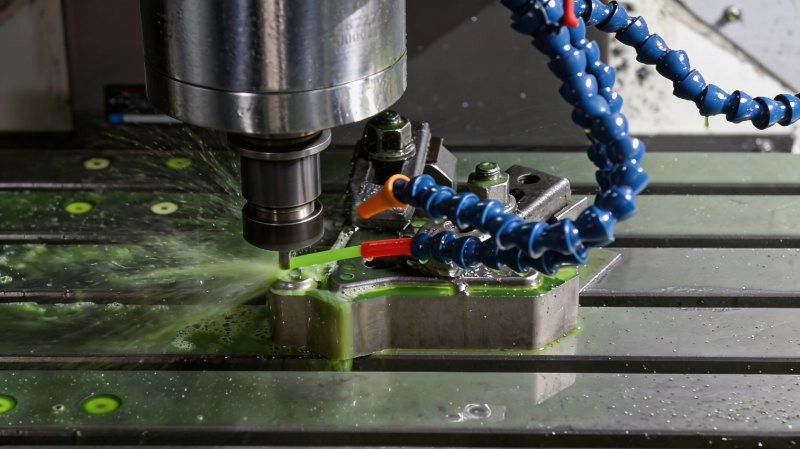
A hydraulic valve block controls or directs hydraulic fluid through a network of internal passages. The external shape may appear straightforward, but the internal structure is often much more complex.
Depending on the design, the block may require:
· Multiple intersecting drilled passages
· Precision mounting holes
· Threaded ports
· Valve installation bores
· Sealing grooves
· Flat mounting surfaces
· Counterbores and stepped holes
· Accurate external profiles
These features have to maintain their intended positions relative to one another. If a mounting surface is not sufficiently flat, if a threaded port is incorrectly positioned, or if an internal bore deviates from its specified dimension, the final assembly may not perform as intended.
CNC milling is particularly useful for producing the external surfaces, pockets, mounting areas, contours, and other geometric features of the block. Milling is normally combined with drilling, boring, tapping, and other machining operations to complete the component.
Material selection should be confirmed before determining the machining process.
Hydraulic valve blocks can be produced from materials such as aluminum alloys, carbon steel, alloy steel, ductile iron, stainless steel, and other suitable engineering materials. Each material behaves differently under cutting forces and heat.
For example, aluminum can generally be machined efficiently but may require appropriate tooling and chip evacuation to maintain surface quality. Steel and stainless steel can require different cutting parameters and tool strategies because of their higher cutting resistance. Ductile and gray cast irons also have their own machining characteristics.
Hehua's CNC machining capability covers ductile iron including QT450-10 and QT700-2, gray cast iron such as HT250 and HT300, carbon steel, alloy steel, 304/316 stainless steel, aluminum alloy, brass, copper, and engineering plastics such as POM and nylon.
Material traceability is also important when valve blocks are used in demanding hydraulic systems. Material spectrum analysis and mechanical property test reports can be provided for each batch, helping customers maintain documentation from raw material through finished machining.
One of the most important machining challenges for a hydraulic valve block is the hole system.
Unlike a simple drilled component, a valve block can contain several holes that intersect at different angles and depths. These passages may need to connect accurately while remaining within specified dimensional limits.
The requirements may include:
· Hole diameter
· Hole depth
· Hole position
· Hole-to-hole relationship
· Bore diameter
· Thread dimensions
· Counterbore dimensions
· Surface finish
Boring can be used where tighter internal diameter control is required. Hehua's stated boring tolerance can reach ±0.005 mm, while drilling and tapping tolerance can reach ±0.02 mm depending on the component and process requirements.
The important point is that these operations should be planned as one machining system rather than as unrelated processes.
Hydraulic valve blocks often connect to other components through precision mounting faces. These surfaces may need to remain flat and smooth enough to support reliable assembly and sealing.
A part can meet its overall dimensional requirements while still having problems if a critical mounting surface is not sufficiently flat.
Hehua specifies flatness capability of ≤0.02 mm/100 mm and surface roughness from approximately Ra0.8 to Ra3.2, depending on the application.
For sealing areas, the required surface finish and dimensional tolerance should be defined according to the actual seal and assembly design.
This is one reason drawing review is important before machining. A supplier should identify which surfaces are functionally critical instead of applying identical machining requirements to every area of the block.
The geometry of a hydraulic valve block determines the machining strategy.
A relatively simple block may be completed using a vertical machining center with several drilling and milling operations. More complicated designs may benefit from horizontal machining, multi-face machining, or turn-mill capabilities.
Hehua operates vertical and horizontal CNC machining centers, turn-mill composite machining centers, CNC lathes, CNC boring machines, and drill-tap centers.
Its full-process CNC capability covers milling, turning, boring, drilling, reaming, tapping, chamfering, rolling, and other operations.
This integrated approach can reduce the number of external processing transfers. Keeping more operations within one controlled production system also helps reduce the dimensional variation that can occur when a component is repeatedly transported, repositioned, and processed by different suppliers.
For complex valve blocks, this can be especially useful because the relationship between multiple machined features is often more important than the accuracy of an individual feature alone.
Not every dimension on a hydraulic valve block needs an extremely tight tolerance.
The more practical approach is to identify the features that directly affect hydraulic performance and assembly.
For example, a valve installation bore may require tighter dimensional control than a non-functional external surface. A mounting face may have a specific flatness requirement, while a sealing groove may need controlled width, depth, and surface finish.
ForMilling services, Hehua specifies CNC milling tolerance of approximately ±0.008–±0.03 mm depending on the machining requirements.
This provides a useful capability range for custom parts, but the final tolerance should always be confirmed from the customer's drawing and application requirements.
Applying unnecessarily tight tolerances to every dimension can make production more difficult without improving the valve block's actual performance. A properly reviewed drawing allows the machining process to focus accuracy where it matters.
Machining accuracy needs to be measured rather than assumed.
For hydraulic valve blocks, inspection may involve checking external dimensions, hole locations, mounting surfaces, flatness, bores, and other critical features. Because many of these dimensions have relationships with one another, CMM inspection can provide useful verification of the finished component.
Hehua uses first-article CMM inspection, regular in-process inspection, and 100% inspection of key dimensions according to project requirements. A complete dimensional inspection report can also be provided with shipment.
This is particularly valuable during new-product development. The first article can be checked against the engineering drawing before the project moves into larger production quantities.
For customers with strict quality documentation requirements, the inspection records also provide a traceable reference for production batches.
Many machining problems can be identified before production starts.
Hehua supports 2D CAD and common 3D formats including STEP, IGS, SolidWorks, and UG. Its engineering team can review drawings within 24 hours and identify potential manufacturing risks.
For a hydraulic valve block, this review can focus on:
· Tool accessibility
· Hole intersections
· Machining sequence
· Tight-tolerance areas
· Clamping requirements
· Surface finish
· Inspection accessibility
· Potential deformation
This is especially useful for OEM customers developing new valve block designs.
If a physical component already exists but its original drawings are unavailable, reverse engineering can also be considered. Hehua supports reverse mapping from physical samples for applications such as imported-part replacement, old equipment component reproduction, and non-standard component development.
Hydraulic components can operate under demanding conditions, so quality control should cover more than the final machining dimensions.
Hehua implements an ISO 9001 quality management system with controls covering incoming material inspection, first-article inspection, in-process inspection, final inspection, and finished-product verification.
For key pressure-bearing components, ultrasonic testing or magnetic particle testing can be provided when required.
This is relevant when hydraulic valve blocks are used in high-pressure working conditions or safety-critical equipment. Combining material traceability, machining records, dimensional inspection, and additional testing creates a more complete quality-control process.
Valve block projects may begin with a small number of samples before moving into trial production and regular orders. The machining supplier therefore needs to support both development and repeat production.
Hehua supports rapid sampling, with typical sample production completed within 3–7 days. A dedicated engineer can assist with drawing review and DFM optimization before production.
The company operates more than 10 CNC machining centers and has supporting casting and forging capabilities. Its monthly production capacity can reach more than 50,000 pieces across its machining operations.
This allows the same supplier to support different project stages rather than requiring customers to change manufacturers when moving from prototype development to larger production quantities.
For hydraulic valve blocks, machining is rarely limited to milling.
The finished component may require milling for external profiles, drilling for hydraulic passages, boring for precision internal diameters, tapping for ports, and additional finishing or surface treatment.
Hehua can coordinate these processes within its CNC machining system and also provide post-processing such as anodizing, black oxide, galvanizing, nickel plating, passivation, powder coating, and other treatments according to material and application requirements.
This one-stop approach can simplify supplier coordination while keeping more of the manufacturing process traceable.
A suitable hydraulic valve block machining supplier should be able to discuss the actual engineering requirements instead of simply providing a machining capability list.
The important questions include whether the supplier can process the required material, achieve the specified tolerances, manage complex hole systems, inspect critical dimensions, provide quality documentation, and maintain consistency when production quantities increase.
Hehua Machinery Technology (Kunshan) Co., Ltd. has supported high-end equipment manufacturing applications since its establishment in 2018 as a subsidiary of Shanghai Hehua Machinery Technology Co., Ltd., which was established in 2005. The company serves industries including automotive, rail transit, aerospace, wind power, nuclear power, industrial machinery, new energy equipment, and semiconductor equipment manufacturing.
With a manufacturing plant of more than 17,800 square meters and over 160 employees, Hehua provides engineering, machining, inspection, surface treatment, assembly, and export support. Its certifications include ISO 9001 and IATF 16949, along with EN 15085 for rail vehicle and parts welding systems.
For OEM customers developing hydraulic valve blocks, the combination of controlled CNC machining, multi-process capability, engineering review, and documented inspection is more important than simply choosing a machine with a high nominal accuracy.
When the machining process is planned around the valve block's actual functional requirements, Milling services become part of a complete manufacturing solution that can support prototype development, stable production, and consistent component quality.


 AddressNo. 66 Xingpu Road, Lujia Town,Kunshan City, Factory Buildings 3 and 4
  en
en
 English
 繁体中文
繁体中文 Italian
 Spanish
 Japanese
 Portuguese
 Korean
 Russian
 French
 German
 Estonian
 Arabic
 Indonesian


 Message