High-volume metal part production is not only about making more pieces in less time. For most OEM and industrial programs, the real challenge is producing large quantities while keeping dimensions stable, surfaces consistent, and downstream assembly efficient. That is why precision metal stamping continues to be one of the most widely used manufacturing methods for repeat metal parts.
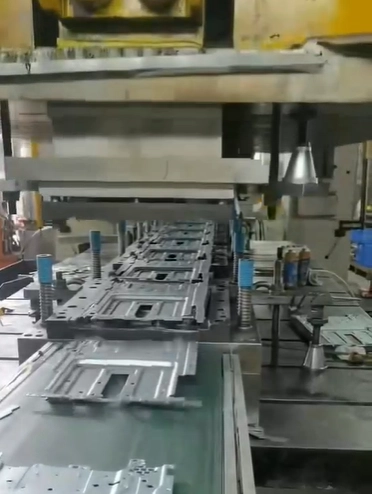
When the part design is suitable, stamping can combine speed, consistency, and process efficiency in a way that many other methods cannot match. On Hehua Machinery's metal stamping and forming page, stamping is presented as a core manufacturing capability, while the Progressive Die Stamping page explains how the process supports high-speed mass production, precision dimensions, complex forming, good surface quality, and material saving. Those points are exactly why precision stamping is often selected for high-volume metal parts.
A production method can be fast and still fail a high-volume program if it creates too much variation, too many secondary operations, or too much manual correction. High-volume manufacturing depends on rhythm. The process needs to keep running, maintain quality, and support parts that go directly into assembly without repeated adjustment.
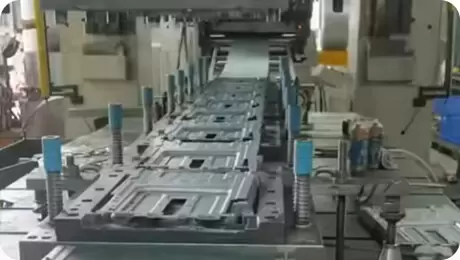
This is where precision stamping becomes useful. Hehua's process description notes that progressive die production can run at 200 to 800 times per minute and achieve daily output of roughly 100,000 to 500,000 pieces in a single shift. That kind of range is important because it shows the process is designed for sustained output, not only for small-batch trial work. The same page also states that stamping cost can be 60 to 80 percent lower than machining for suitable parts, which explains why stamping is often preferred once part volume rises.
For buyers, the advantage is straightforward. If the program involves repeat parts over a long production cycle, a stable stamping line is often easier to manage than a slower route built around multiple separate operations.
High-volume parts are often used in systems that depend on interchangeability. If the hole position changes too much, if the edges are inconsistent, or if flatness moves outside the acceptable range, assembly becomes slower and defect risk increases.
Precision metal stamping is used in these situations because the process can hold repeat geometry over long runs when tooling and feeding are controlled correctly. According to Hehua's published capability data, its progressive die process supports blanking accuracy of ±0.01 mm and hole pitch accuracy of ±0.02 mm. Servo roller feeding with step accuracy of ±0.005 mm is also listed, which shows how feed control supports dimensional stability.
Those values matter in practical production because they reduce the need for secondary machining or adjustment. In high-volume manufacturing, even a small reduction in rework or fitting time can have a large impact across the full batch.
Another reason precision stamping is widely used for high-volume parts is that it can combine several operations within one die flow.
Hehua's process description explains that progressive stamping can use multiple stations for deep drawing, punching, flanging, and shaping. This makes it possible to produce box structures, shells, flanges, and reinforcement ribs in a continuous route.
That kind of process integration is important in high-volume work. If a part requires several separate machines and repeated handling, variation usually increases and output rhythm slows down. If the same part can move through one coordinated tooling system, production becomes simpler to control.
For parts that need both shape complexity and production scale, this is one of the main reasons stamping remains competitive.
High-volume parts are not all made from the same material. Different industries use different sheet properties depending on strength, conductivity, corrosion resistance, weight, or magnetic performance.
Hehua’s capability page lists workable material thickness ranges of 0.05 mm to 12 mm for steel, 0.1 mm to 8 mm for stainless steel, and 0.1 mm to 10 mm for aluminum.
This matters because part volume alone does not define process choice. The supplier also needs to support the material category. A stamping system that can handle thin precision material and thicker structural metal is more useful for OEM programs with mixed part families.
For buyers, this also means the supplier is less likely to be limited to only one narrow segment of stamped products.
When only a few samples are produced, surface defects may seem manageable. In high-volume production, they become much more serious. Burrs, scratches, poor edge condition, or surface damage on coated material can create sorting, rework, or assembly issues at scale.
Hehua states that cold rolled sheet can maintain surface roughness of Ra ≤ 0.8 μm and that galvanized or coated sheet can keep its original appearance after stamping.
That kind of surface stability is one reason precision stamping is chosen for large-volume parts. A repeatable process helps preserve appearance and edge quality over long runs, which is especially useful for parts moving directly into assembly or additional downstream processes.
In high-volume manufacturing, surface control is not just about appearance. It is about keeping the full process stable.
Material utilization may not look critical in a short run, but it becomes far more important when production volume rises. Even a small percentage difference in strip layout can have a large effect when parts are produced in the hundreds of thousands or millions.
Hehua’s page states that closed material layout can achieve utilization of at least 85 percent, which is especially relevant for stainless steel thin materials and other higher-value metals.
This is another reason precision stamping is often selected for high-volume parts. Once the die is optimized, material use becomes more predictable and more efficient, helping the supplier keep production disciplined over time.
The strongest argument for precision stamping is not theory. It is production evidence.
Hehua’s case section provides three examples that show different forms of high-volume advantage.
The first case is a new energy motor core made from 0.35 mm non-oriented silicon steel coil. The part has an outer diameter of 180 mm, 72 slots, and thickness of 40 mm with stacked riveting. The process uses a 72-station progressive mold plus rotating stacking riveting and online burr detection of ≤0.02 mm. The reported result is flatness ≤0.05 mm, iron loss ≤2.4 W/kg, and monthly output of 1.2 million pieces.
This case shows why stamping works for parts that need both geometry control and large production scale.
The second case is a car door hinge made from 4 mm B340LA high-strength steel. The process uses an 800-ton servo press and a three-axis transfer arm with a 7-station transfer mold. The result is side-hole positional accuracy of 0.08 mm, with no machining required and annual capacity of 800,000 sets.
This case shows that high-volume stamping is not limited to simple thin parts. It can also support shaped structural components where consistent feature location matters.
The third case is a 5G RF shielding cover made from 0.2 mm phosphor bronze, featuring 128 small louvers and convex bulges. Produced on a 125-ton high-speed punch at 600 SPM, the result is burr-free louvers, shielding effectiveness above 100 dB, and monthly output of 5 million pieces.
This example highlights another side of precision stamping: very high-volume output for fine-feature parts where consistency is just as important as speed.
High-volume production needs more than a fast press. It needs a controlled system around the press.
Hehua's mold and automation section mentions self-designed progressive, transfer, and composite molds, simulation forming to reduce trial molds by 40 percent, in-mold tapping and riveting, robot and visual feeding, automatic roll change, and online detection using visual size, pressure curve, and leak detection. The page also states defect rate can be kept to 50 PPM or below.
These details matter because at high volume, process stability depends heavily on automation and monitoring. A line that relies too much on manual correction may still produce parts, but it becomes harder to keep output and quality consistent over time.
High-volume programs usually run over long periods, which makes traceability more important. If a problem appears in one batch, the supplier needs to identify the cause quickly.
Hehua's quality and traceability section states that its stamping process follows the IATF 16949 automotive stamping system and ISO 9013 punching accuracy standard. It also describes first-piece full-size inspection, 10 percent inspection, last-piece comparison, MES data upload, and QR code plus visual engraving for mold number, roll number, and operator trace-back to raw material furnace number.
This is one more reason precision stamping is used in high-volume programs. It is not only fast. It can also be structured in a way that supports long-term quality control.
Precision metal stamping is used for high-volume metal parts because it combines output speed with process discipline. It supports large batch production, tight dimensional consistency, multi-step forming, better material use, stable surface quality, and practical traceability.
Based on Hehua Machinery's published stamping capabilities and case examples, the process is especially suitable where OEM and industrial buyers need more than capacity alone. They need repeatable results over time, across large volumes, and across different types of parts. That is where precision stamping becomes not just a production option, but a manufacturing strategy.


 AddressNo. 66 Xingpu Road, Lujia Town,Kunshan City, Factory Buildings 3 and 4
  en
en
 English
 繁体中文
繁体中文 Italian
 Spanish
 Japanese
 Portuguese
 Korean
 Russian
 French
 German
 Estonian
 Arabic
 Indonesian



 Message