Choosing a metal stamping supplier is not just about finding a factory with presses. For OEM buyers, the more important question is whether the supplier can match the part design, production volume, dimensional targets, and downstream assembly requirements with a process that stays stable over time.
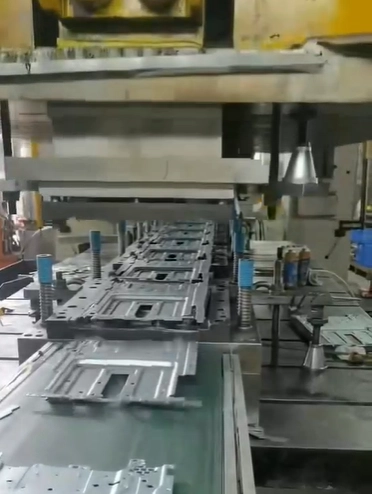
That is especially true when the project involves precision stamped parts, high-volume demand, or multi-step forming. On Hehua Machinery's Metal Stamping & Forming page, the company presents stamping as part of its core competency, with progressive die stamping positioned as a key solution for custom metal parts and industrial applications.
For buyers sourcing in China, a reliable supplier should be able to explain not only what equipment they have, but also what kinds of parts stamping can realistically solve. On Hehua’s Progressive Die Stamping page, the process is described as suitable for high-speed mass production, complex three-dimensional forms, high dimensional precision, good surface quality, and better material utilization. Specifically, the page states that progressive die lines can run at 200 to 800 times per minute, produce roughly 100,000 to 500,000 pieces per shift, achieve ±0.01 mm blanking accuracy with hole position accuracy of ≤0.02 mm, and support material utilization of at least 85% through closed strip layout.
A dependable supplier should first judge whether metal stamping is actually the correct manufacturing route. Some parts are better suited to machining, some to welded fabrication, and some to stamping. A good stamping supplier will not simply say yes to every drawing. They should be able to explain whether the part benefits from progressive die production, whether multiple forming stations are needed, and whether the design can move directly into stable batch production.
This matters because stamping works best when the part has repeatable geometry, defined material behavior, and enough volume to justify tooling and process setup. Hehua’s process description highlights that stamping is especially effective when a part needs several operations combined into one workflow, such as deep drawing, punching, flanging, and shaping, to produce shells, box structures, flanges, and reinforcement ribs.
If a supplier cannot explain where stamping adds value, that usually means they are selling capacity rather than process judgment.
Many suppliers list press capacity, but that alone does not show whether they fit your project. Buyers should ask how the supplier matches press type, die size, material thickness, feed control, and changeover efficiency to actual part requirements.
Hehua’s progressive die stamping page gives a clearer example of the kind of information buyers should look for. The site lists maximum press capacity from 25 t to 800 t mechanical and up to 1250 t servo, progressive die size up to 2500 × 1200 mm, material thickness ranges of 0.05 mm to 12 mm for steel, 0.1 mm to 8 mm for stainless steel, and 0.1 mm to 10 mm for aluminum. It also states servo roller feeding with ±0.005 mm step accuracy, batch capacity from 1 to 1,000,000 pieces, and die change in under 15 minutes using a quick clamping system.
Those details matter because a reliable supplier should be able to support more than one production scenario. Some OEM programs begin with sampling and pilot orders, then move to mass production. Others require frequent part changeovers or a mix of different materials. A supplier with the right equipment range but poor batch flexibility may still become difficult to work with.
For precision stamping, the die is not just an accessory. It is the core of the production system. That is why buyers should pay close attention to tooling capability, not just machine count.
Hehua states that it uses self-designed progressive, transfer, and composite molds, supported by MaxProgress simulation forming to reduce trial molds by 40 percent. The page also lists mold materials such as SKD11, CD53, and hard alloy inserts, with die life of at least 100 million hits. It further notes integrated in-die tapping, riveting, and injection molding options to reduce post-processing.
For buyers, this kind of information is useful because it shows whether the supplier is prepared to manage part complexity at the tooling level. A factory that depends entirely on basic trial-and-error adjustments may struggle with consistent quality later, especially on high-volume OEM programs.
Stamping covers a wide range of parts. A supplier may be strong in small electronic stampings but less capable with larger automotive structural parts. Another may be good at blanking and punching but weaker in shaped components that require deeper forming.
Hehua’s equipment list illustrates why part-type fit matters. Its AIDA NC1-800 servo press is described as suitable for deep drawing of large automotive coverings and forming of high-strength steel, while AIDA NC1-200 units are positioned for precision punching, material cutting, motor iron cores, and connector spring plates. The Bruderer BSTA 125 is described as supporting 0.1 mm stainless steel electronic connectors with multi-station progressive design, and the Yamada Dobby 60 t line is used for small precision parts with in-mold tapping from M1 to M3.
This is the sort of alignment buyers should check. A supplier becomes more reliable when they can explain which production line fits which part family, instead of treating all stamped parts as interchangeable.
A serious supplier should be able to show what kinds of parts they have already made and what results they achieved.
Hehua’s page includes three case examples that help buyers understand application range. One is a new energy motor core made from 0.35 mm non-oriented silicon steel coil, produced with a 72-station progressive mold plus rotating stacking riveting and online burr detection ≤0.02 mm; the stated result is flatness ≤0.05 mm, iron loss ≤2.4 W/kg, and monthly production of 1.2 million pieces. Another is a car door hinge made from 4 mm B340LA high-strength steel using an 800-ton servo press and a 7-station transfer mold; the page states side-hole positional accuracy of 0.08 mm, with no machining required and annual capacity of 800,000 sets. The third is a 5G RF shielding cover made from 0.2 mm phosphor bronze, produced on a 125-ton high-speed punch at 600 SPM, with burr-free louvers and shielding effectiveness above 100 dB.
For buyers, this kind of application evidence is often more meaningful than broad marketing language. It shows whether the supplier has experience with thin materials, high-strength steel, micro features, automotive parts, or high-output precision production.
A reliable stamping supplier should not talk about quality only at the end of production. Quality should be built into the process.
Hehua links its stamping quality system to IATF 16949 and ISO 9013 punching accuracy standards. The page also states that each batch goes through first-piece full-size inspection, 10 percent inspection during production, and final-piece comparison, with data uploaded automatically to MES. For traceability, Hehua says it uses QR code and visual engraving to mark mold number, roll number, and operator information, allowing trace-back to raw material furnace number.
This matters for OEM buyers because when a quality issue appears, the ability to trace it quickly is often as important as the original inspection itself.
Automation does not matter because it sounds advanced. It matters because it reduces variability, improves changeover efficiency, and supports more stable output.
Hehua’s page notes robot and visual feeding, automatic roll change, material utilization of at least 85 percent, and online detection combining visual size checks, pressure curve control, and leak detection, with stated defect rate ≤50 PPM.
A supplier with this kind of setup is generally better prepared for real OEM programs than one that depends heavily on manual transfer and late-stage sorting.
A reliable metal stamping services supplier in China should do more than offer press capacity. They should be able to explain what stamping solves, match equipment and tooling to the part, demonstrate relevant case experience, and manage quality through repeatable systems.
From the information published by Hehua Machinery, the company presents stamping as a core manufacturing capability and positions progressive die stamping as a practical route for high-speed, high-precision, and material-efficient production across automotive, electronic, and industrial applications.
For buyers, that is the right way to evaluate a supplier: not by looking at one machine, but by checking whether the entire process can support real production requirements from tooling to output to traceability.


 AddressNo. 66 Xingpu Road, Lujia Town,Kunshan City, Factory Buildings 3 and 4
  en
en
 English
 繁体中文
繁体中文 Italian
 Spanish
 Japanese
 Portuguese
 Korean
 Russian
 French
 German
 Estonian
 Arabic
 Indonesian


 Message