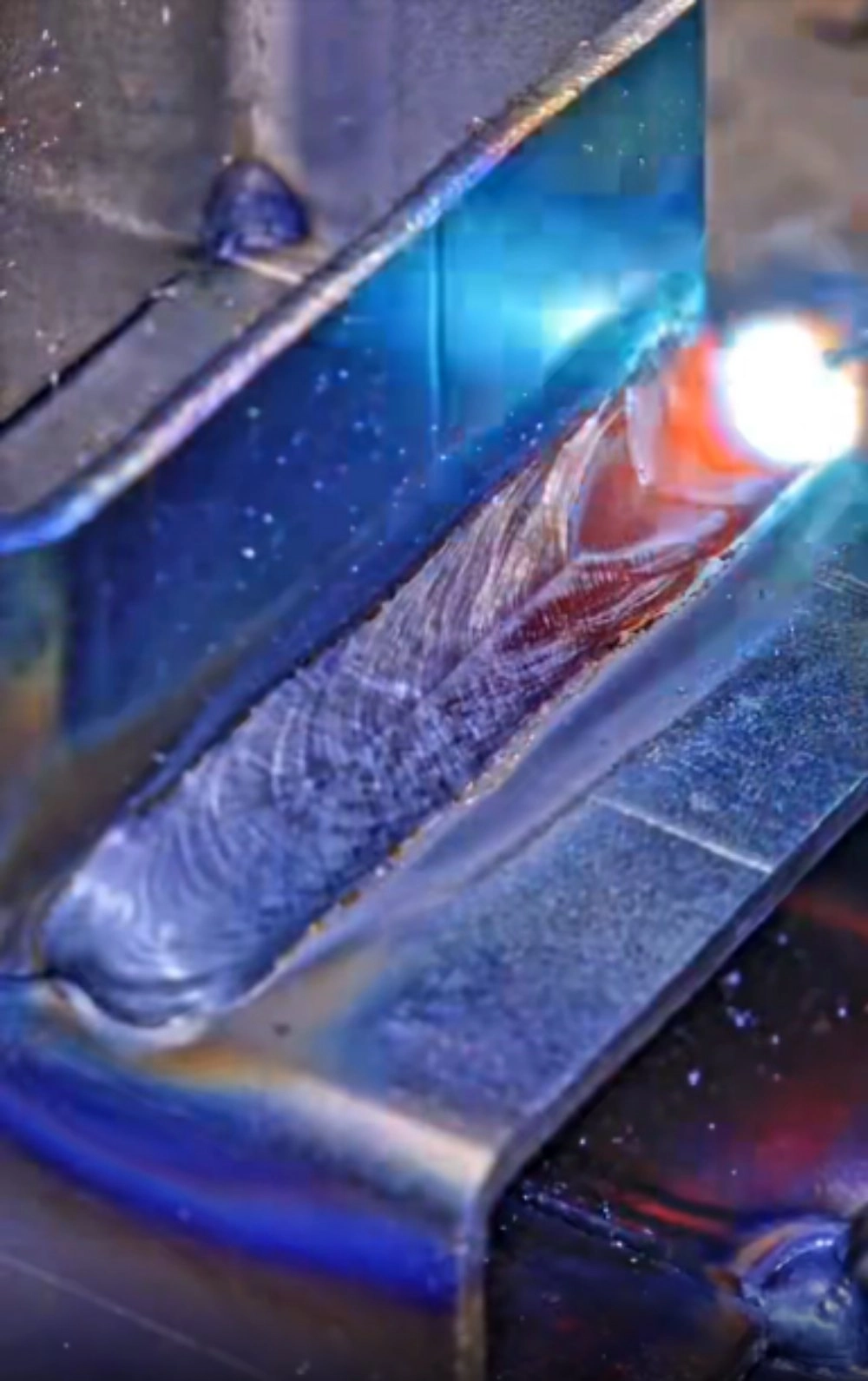
For many industrial buyers, choosing a MIG welding supplier is not simply about finding a factory that can join metal. The more important question is whether the supplier can keep weld quality stable across different materials, seam types, thickness ranges, and batch sizes. In real projects, a welding service becomes reliable when it can turn process capability into repeatable production results.
That is especially true for gas shielded welding used in industrial equipment, motor components, structural parts, and battery-related assemblies. On Hehua Machinery’s MIG Welding, the process is presented as a solution for high deposition rate, wide thickness coverage, low spatter, all-position welding, and compatibility with multiple materials. Those are good starting points, but buyers should look more closely at how these capabilities translate into actual project support.
A reliable MIG welding supplier should be able to explain the practical value of the process, not just name the machines in the workshop.
Hehua’s page describes several clear process advantages. It states that with 1.2 mm solid wire at 300 A, gas shielded welding can reach a deposition rate of 5 kg/h, about three times faster than manual arc welding. It also states that one process route can cover plate thickness from 0.8 mm automotive sheet up to 60 mm thick multi-layer welding. Pulse and double-pulse modes are said to keep spatter at no more than 1 g/min, which greatly reduces post-weld cleaning. The page also notes that six-axis robot systems with external axis programming can cover flat, horizontal, vertical, overhead, and circumferential seams in one program path.
For buyers, this matters because a welding supplier should not be evaluated only by whether they “do MIG welding.” They should be evaluated by whether MIG welding is the right solution for the actual part. If the supplier can explain what the process solves in terms of speed, spatter, position, and material compatibility, that usually shows stronger process understanding.
Many buyers focus on material and thickness, but weld type is just as important. A reliable supplier should be able to explain how they handle different seam conditions and part geometries.
Hehua lists support for butt welds, fillet welds, lap welds, circumferential seams, and 3D curved seams. It also states all-position welding capability, including flat, horizontal, vertical, overhead, and full 360-degree circumferential welding.
This is useful because actual projects rarely stay within one simple seam type. A motor base may require circumferential seam control, a battery enclosure may depend on continuous corner welds, and a structural part may require thick multi-pass groove welding. If a supplier cannot explain how their process changes with seam type, the project risk is higher.
A stronger welding supplier should be able to tell you not only that they can weld the part, but also how the seam type affects process choice, travel speed, deformation control, and inspection method.
A machine list is helpful, but only when it is connected to actual application fit. Buyers should ask whether the supplier’s equipment is suited to the parts they need welded.
Hehua’s MIG welding page lists several equipment combinations. The Fronius TPS 500i Pulse with FANUC M-20iA is described for carbon steel and stainless steel from 0.8 mm to 8 mm, with spatter no more than 1 g/min. The Lincoln Power Wave S500 with KUKA KR30 HA is listed for aluminum-magnesium alloy from 1 mm to 12 mm, with robot repeatability of ±0.02 mm. A MAG robot island with three 500 A double-wire systems is described for 60 mm thick plate multi-layer welding, with a 40 percent cycle-time increase, especially for construction machinery boom applications. In addition, six 350 A CO₂ handheld units are used for prototype welding repair, first-piece verification, and real-time current and voltage acquisition.
This kind of breakdown is important. It shows that different equipment cells are assigned to different welding tasks. A reliable supplier should not rely on one generic welding setup for all projects. They should match the power source, robot system, and welding mode to the material and seam condition.
A lot of welding projects do not start at full scale. They may begin with prototype verification, then move into pilot production, and later into stable repeat orders. A supplier that only handles one stage well may not be the best long-term choice.
Hehua’s page lists batch capacity from 1 to 100,000 pieces per batch and states support for 24-hour continuous operation. It also notes the use of handheld CO₂ welding stations for prototype welding repair and first-piece verification in larger orders.
That matters because reliability often depends on flexibility. A supplier should be able to support sample development without losing process control later in volume production. If they can verify first pieces, adjust process windows, and then move into automated production with the same project logic, that usually creates a smoother supplier relationship.
Material compatibility is another key point in MIG welding. The supplier should be able to explain which materials they weld, how they select gas combinations, and what welding mode is used for each material family.
Hehua states that its process can cover carbon steel, stainless steel, aluminum, copper silicon alloy, and dissimilar steel combinations such as Q355 plus 304L. It also gives gas examples: 80 percent Ar plus 20 percent CO₂ for carbon steel and stainless steel, Ar plus 30 percent He for aluminum-magnesium alloy, and pure CO₂ for low-cost thick plate applications. The page explains that different gas systems are connected to spatter control, weld brightness, deep penetration, and porosity performance.
For buyers, this shows whether the supplier understands welding as a controlled process rather than a general workshop operation. When the supplier can explain material-to-process matching clearly, the chance of unstable weld results is lower.
One of the most practical ways to evaluate a MIG welding supplier is to look at application examples.
Hehua provides three case studies on the page. The first is a WEG motor base MAG ring seam using Q355B hot-rolled plate, 4 mm thick and 400 mm in diameter. The process uses MAG pulse 280 A with 80 percent Ar and 20 percent CO₂ at robot speed of 0.6 m/min. The result is 4.5 mm penetration depth, no undercut, X-ray Grade I film rate of 99 percent, and monthly production of 50,000 pieces.
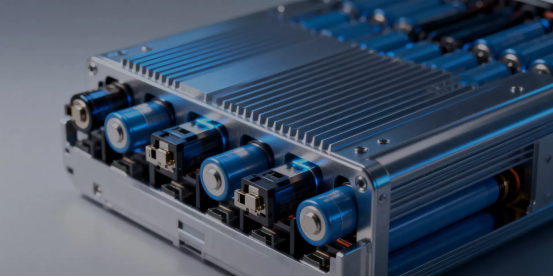
The second is continuous MAG welding of a new energy battery aluminum shell made from 6061-T6 extruded profile, 3 mm thick, with continuous corner joints over a total weld length of 1.8 meters. The process uses double pulse 220 A with Ar and He mixed gas and interpass temperature control of no more than 80°C. The reported result is deformation no more than 0.3 mm, helium leak detection of ≤1 × 10⁻⁶ Pa·m³/s, and 800,000 pieces in batch production with no leakage.
The third is a construction machinery thick plate case using Q690D high-strength steel, 40 mm thick, with double-sided groove welding. The process uses MAG dual wire 500 A plus 400 A, multi-layer and multi-pass welding, and 3 mm robot oscillation. The result is impact toughness of at least 47 J at -40°C, tensile strength of at least 690 MPa, and 25 percent savings in welding materials.
These examples matter because they show the supplier’s process across very different part types: motor components, battery enclosures, and heavy machinery structures. That range is often a strong sign of reliability.
A reliable supplier should be able to explain how weld quality is controlled before defects become shipment problems.
Hehua states that it uses ISO 15614-1 MAG welding process certification. It also lists online laser weld seam tracking for real-time compensation of width and offset, with automatic marking of defects. For traceability, the page mentions QR code engraving tied to furnace number, welder number, current, voltage, and speed. It also states that each batch includes first-piece profile checking, tensile and bending tests, plus 10 percent appearance inspection and ultrasonic sampling in mass production.
This is the sort of system buyers should look for. Reliability in welding depends on process records, not only final repair work. If the supplier can trace welding parameters and batch data, it becomes much easier to support OEM and industrial customers over time.
Efficiency is not only about speed. It also affects cost stability, process consistency, and long-term production planning.
Hehua notes that its robot plus power supply system uses 8 kW and can save 30 percent compared with manual welding of the same specification. It also connects low-spatter and gas choice to reduced post-weld cleaning and stable bead appearance.
For buyers, this is relevant because a more efficient and controlled welding process is usually easier to scale and manage.
Choosing a reliable MIG welding service in China means looking beyond whether the factory can weld steel. Buyers should evaluate whether the supplier can match welding mode to material, seam type, and production stage, while supporting traceability, low defect risk, and stable batch output.
Based on the information published by Hehua Machinery, its MIG welding operation combines process range, robotic equipment, practical case coverage, gas selection logic, and quality traceability in a way that helps buyers evaluate actual manufacturing reliability. That is the right standard to use: not whether the supplier can make a weld, but whether the full process can support real industrial production.

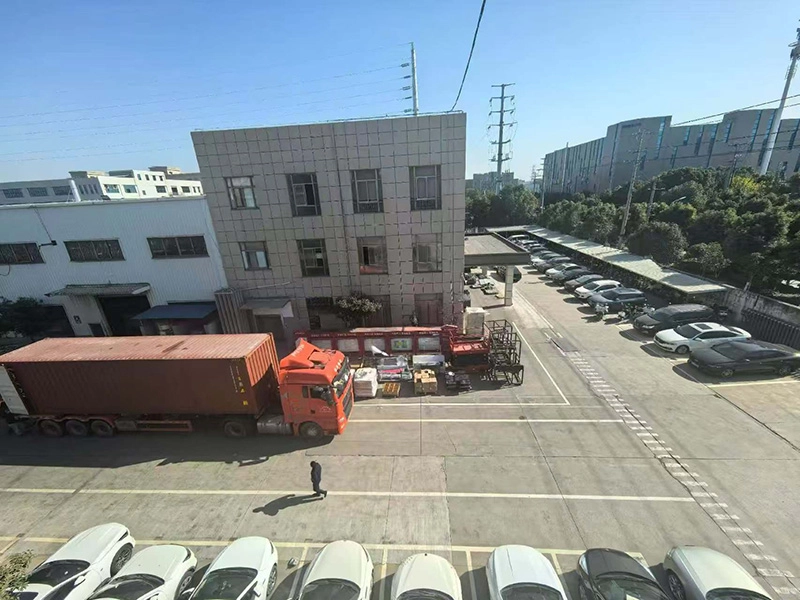

 AddressNo. 66 Xingpu Road, Lujia Town,Kunshan City, Factory Buildings 3 and 4
  en
en
 English
 繁体中文
繁体中文 Italian
 Spanish
 Japanese
 Portuguese
 Korean
 Russian
 French
 German
 Estonian
 Arabic
 Indonesian


 Message