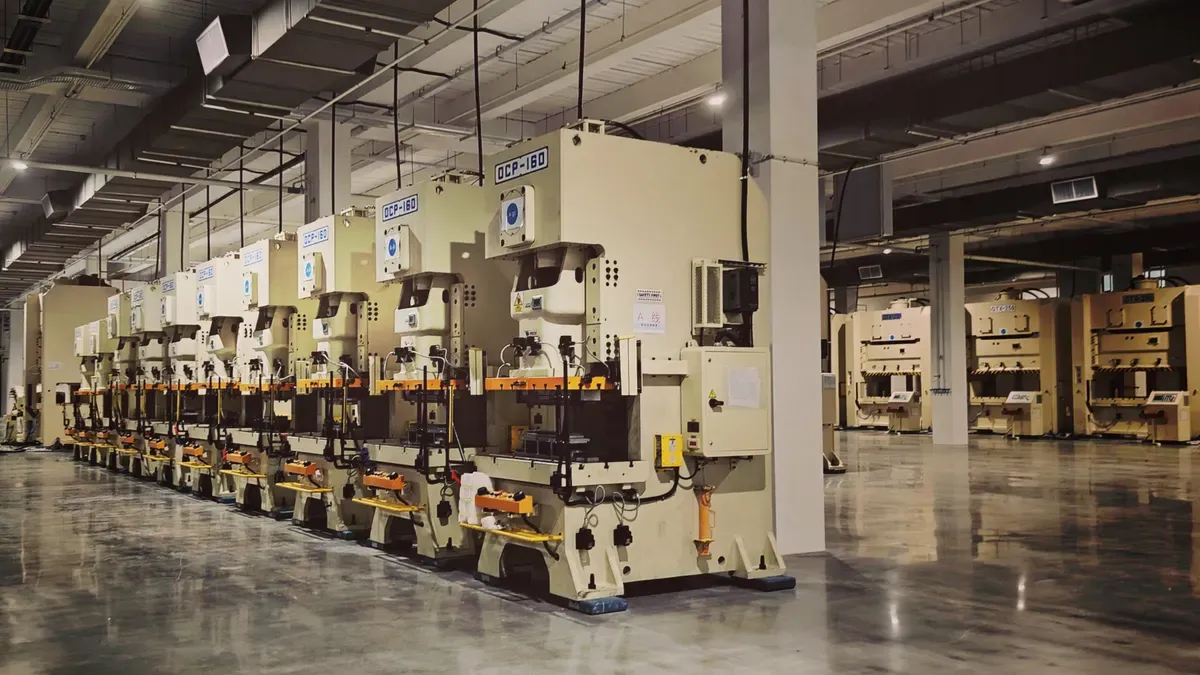
Finding a reliable electronic stamping components supplier in China can feel overwhelming, but with the right plan, it’s actually simple. The trick is to check suppliers carefully, talk clearly, and think about the full cost, not just the price per part. You want a partner who is great at Progressive Die Stamping, makes custom parts with steady quality, and has certifications like ISO 9001. Consider Hehua Machinery Technology (Kunshan) Co., Ltd., a supplier with 30 years of know-how. Their stamping die work can hit tolerances as tight as ±0.008 mm. You’ll learn how to check stamping quality, ask for samples, and negotiate well. This guide helps you steer clear of common mistakes when buying stamping components and stamping die solutions from China.
Check certifications like ISO 9001 and IATF 16949. These show that a supplier is reliable and steady in quality.
Test the samples on your own assembly line. This shows how they really fit and work, not just their numbers.
Send clear technical drawings and use help in two languages. This avoids confusion and saves time.
Add up the total cost: unit price, tooling, shipping, and possible quality problems. A trustworthy partner reduces hidden costs.
Create a long-term relationship to get better prices and quality. Talking regularly leads to good results over time.
Electronic stamping components are exact metal parts made with progressive die forming. In this process, a metal strip moves through a series of dies inside a press. Each station does a different job, like blanking, bending, or forming. The final part has tight tolerances and steady quality.
You can find these parts in many everyday items. Connectors in your phone, terminals in your car, and shielding cans around circuit boards all use stamping. Hehua, for example, makes metal parts for compressors and pneumatic equipment. Their work needs tolerances as tight as ±0.008 mm.
The global market for precision metal stamping parts is large. It hits USD 223.68 billion in 2025 and grows to USD 336.81 billion by 2035. This big market shows how vital electronic components are to modern manufacturing. Without stamping, you cannot build reliable electronics at scale.
China has over 285 wholesale electronic stamping suppliers listed in directories. With so many choices, you need clear criteria to pick the right partner.
First, look for certifications. ISO 9001 covers general quality management. IATF 16949 adds automotive-specific requirements. These certifications show a company's commitment to consistency and traceability.
Certifications like ISO 9001 and especially IATF 16949 are critical indicators. Companies holding them demonstrate a commitment to meeting strict standards. They have processes in place for consistency, traceability, and continuous improvement.
The table below shows common certifications among top suppliers:
Certification | Number of Suppliers Holding It |
|---|---|
ISO 9001 | 6 out of 10 |
IATF 16949 | 3 out of 10 |
ISO 14001 | 2 out of 10 |
ISO 13485 | 1 out of 10 |
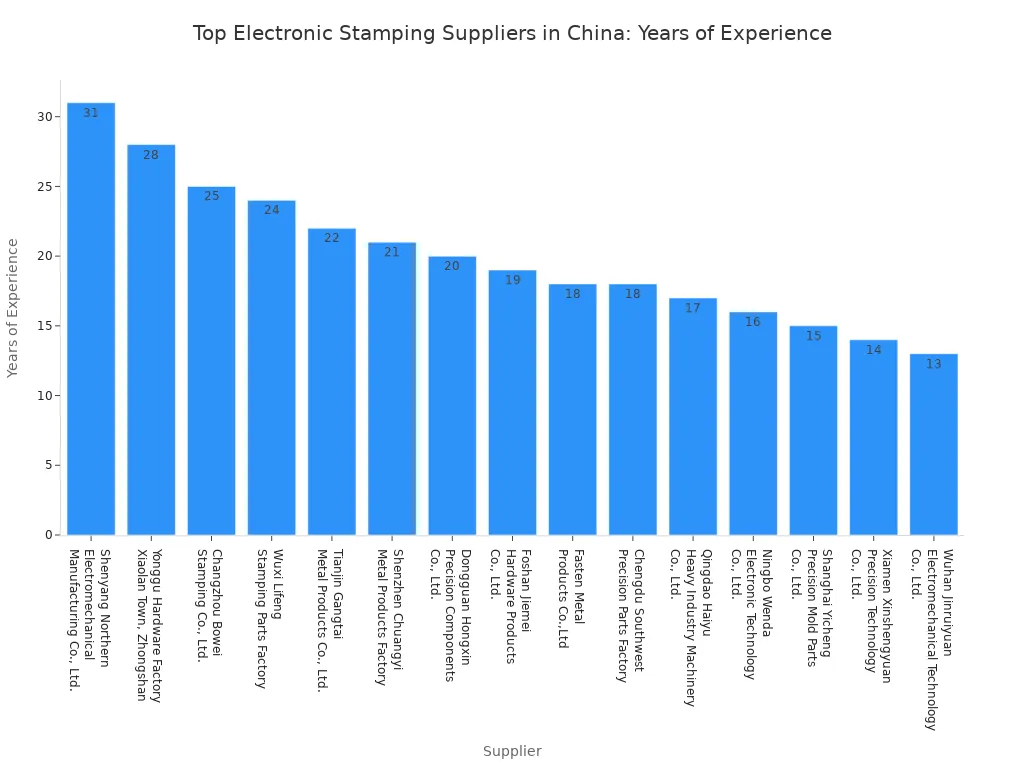
Second, consider experience. The average top company has over 20 years in business. Experience matters because stamping die design requires deep knowledge of material behavior and press capabilities. The chart below shows the years of experience for leading suppliers.
Third, evaluate equipment. Look for press tonnage ranging from 63T to 315T. This range shows the company can handle both small and large parts. In-house mold workshops also matter. They allow faster sampling and stamping die maintenance.
When you need automotive-grade parts, IATF 16949 becomes essential. This standard requires:
Control Plan: Documented process control points
PFMEA: Analysis of potential failure modes
MSA: Validation of measurement equipment
SPC: Real-time monitoring with Cpk ≥ 1.33
Hehua exemplifies these criteria. They hold ISO 9001 and IATF 16949 certifications. With 30 years of experience, they offer a proven track record. Their production capabilities include 63T to 315T presses and rapid sampling within 7 days.
Differentiation is critical. Many metal stamping companies offer similar services. You need to check their quality control processes. When comparing metal stamping companies, look for CMM inspection and 100% key dimension checks. These practices ensure consistent quality for your custom stamping parts.
When you evaluate custom metal stamping suppliers, ask about their mold workshop. A partner with in-house tooling can respond faster to die wear. This reduces downtime and keeps your production running smoothly. Good custom metal stamping projects rely on strong stamping die capabilities.
Precision metal stamping requires attention to material selection. Good suppliers work with cold rolled steel, stainless steel, aluminum, and copper. They also offer surface finishing services like anodizing and powder coating. Your precision metal stamping needs should match their equipment range. Material traceability also matters for quality control.
Remember to calculate total cost. Unit price matters, but tooling costs, shipping, and potential quality failures add up. A reliable stamping die supplier reduces these hidden costs through consistent quality. The stamping die process must deliver repeatable results. On-time delivery rates above 98% also reduce supply chain risks.
By focusing on certifications, experience, and equipment, you narrow your search. You find a partner who delivers consistent custom stamping parts. You avoid the common pitfalls of buying from China.
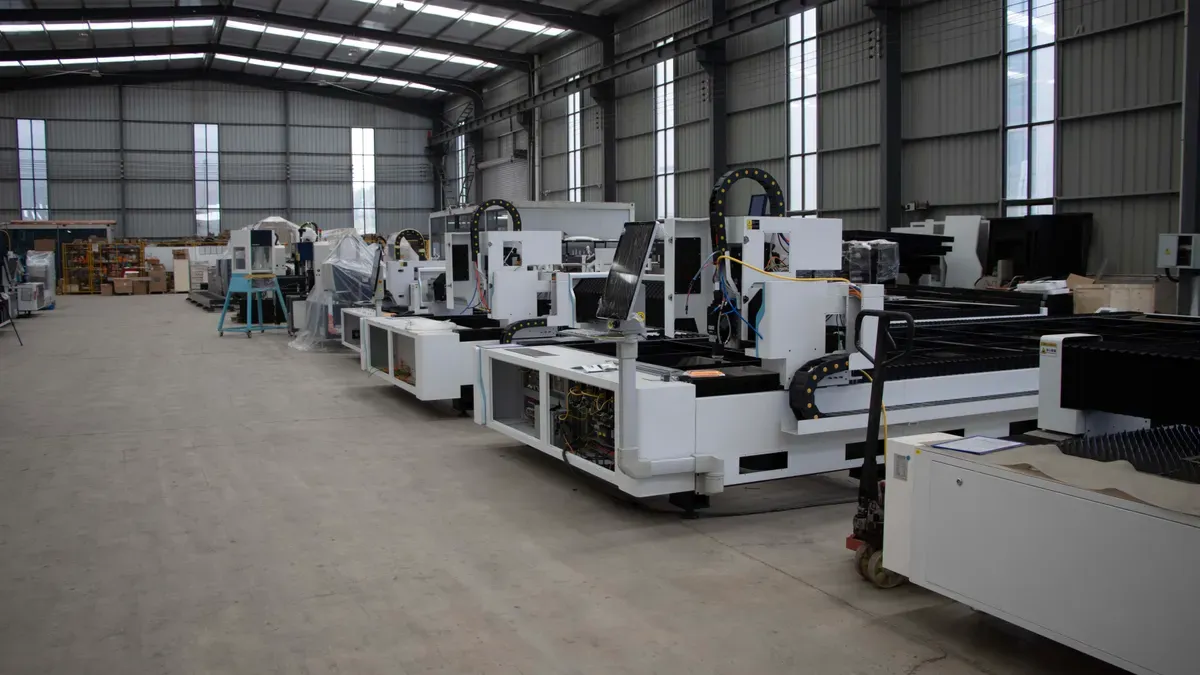
Sample parts show you more than any brochure can. Ask for parts that fit your exact tolerance needs. If your design needs ±0.008 mm precision, ask for parts made at that level. A good electronic stamping components supplier will say yes to this request.
When you ask for samples, ask about the time first. Based on typical Alibaba listings, sample parts from Chinese suppliers take 7–15 working days. This time is for parts from existing tools. If you need a new stamping die, the total time before first parts arrive is 2–6 weeks. Some suppliers also quote FAI (First Article Inspection) samples at 30 days after deposit for first-time tooling. Mass production then follows 15 days after sample approval, if raw materials are ready.
Hehua offers fast sampling in 7 days. Their in-house mold workshop makes this speed happen. You should test every sample in your own assembly line. Measure the parts, fit them into your product, and check how they work under real conditions. Do not skip this step. A part that looks perfect on paper might fail in real use.
Testing samples in your real assembly shows problems that dimensional reports cannot show. Fit, function, and material behavior matter just as much as measurements.
A factory audit gives you direct proof of what a supplier can do. You want to see their mold workshop, press lines, and quality control lab. CMM (Coordinate Measuring Machine) inspection is a key method you should look for. An operator uses a CMM to measure parts very precisely, making sure they meet the ISO 2859-1 standard. This process includes real-time data analysis and checks manufacturing quality.
You should also check for 100% key dimension checks on important parts. Third-party quality control services can give independent checks. These services include factory audits, in-process inspections (IPQC), pre-shipment inspections (PSI), dimensional and functional checks (CMM included), and container loading inspection. They lower sourcing risks and improve product consistency.
Checking IATF 16949 certification takes more than a quick look at a PDF. Follow these steps:
Request the full certificate. Check the legal name, site address, scope, IATF number, and validity dates.
Search the official IATF database at iatfglobaloversight.org. Use the supplier's IATF number to confirm active status.
Check that the issuing body is on the IATF-recognized list.
Make sure the certificate scope includes 'stamping' or related processes.
Check that surveillance audits are current (within 12 months).
A real example shows why this matters. A U.S. client got a certificate from a Southeast Asian supplier. Within 20 minutes, their quality team found the certifying body was not IATF-recognized. That find saved months of wasted development time.
Remember that certification does not prove that a specific die, material lot, or dimension meets your project needs. Keep system scope and part approval separate. Keep a dated verification record. Define who checks status again before nomination or production release. This care ensures your custom metal stamping partner delivers high-precision parts consistently. The best metal stamping companies welcome audits because they have nothing to hide. Your careful check separates reliable partners from risky ones.
Language differences can make your project with an electronic stamping parts supplier harder. Wrong ideas about specs or deadlines cause delays and cost more money. You need a clear plan from the start when working with a Chinese supplier.
Start with technical drawings. A 2D CAD file or 3D STEP/IGS model removes most confusion. Hehua accepts these files and offers DFM changes to your design. This step finds problems before production begins.
In Chinese business culture, 'saving face' is very important. This leads to indirect talk and avoiding direct criticism. Respect and hierarchy matter a lot. Building a relationship through social time is key to a good partnership.
Use bilingual helpers when you can. They understand both language and cultural details. Clear documents also help. Write short, clear contracts and specs. Set regular check-ins to fix problems early.
Challenge | What Happens / What to Do |
|---|---|
Misunderstandings | Cause delays and higher costs |
Cultural differences | Be patient and flexible to work better together |
Misunderstandings | Set up a clear way to talk to avoid delays |
Your specs decide your success. Write everything down. Include tolerances, materials, surface finishes, and inspection needs. Clear, written specs stop costly mistakes and build trust with your supplier.
DFM changes can lower your part price a lot. Supplier ideas usually cut costs by 15–30% while making production more stable. One U.S. client's bracket project found six design changes that cut the part price by 22% without changing how it works.
Specific steps include:
Making bend radii at least 1× material thickness reduces cracking and waste
Loosening non-critical tolerances from ±0.005" to ±0.010" lowers inspection costs by 10–15%
Better part nesting improved material use from 62% to 78%, cutting material cost per part by 12%
These changes also affect your stamping die costs. Making bend radius from 0.5T to 1.0T lowers tooling cost by 8–12% because you can use standard tool steel. A good stamping die gives steady quality over long production runs.
When negotiating, talk about Incoterms, payment terms (T/T, L/C), and lead times up front. Know your total cost: unit price, tooling, shipping, customs, and possible quality failure costs. A reliable partner with a 98% on-time delivery rate lowers supply chain problems. Quality stamping needs attention to every detail.
Remember that the best metal stamping companies welcome your questions. They want long-term partnerships. Your careful planning makes your custom metal stamping project succeed. Precision metal stamping needs this level of detail. Your custom parts deserve nothing less. Quality stamping starts with clear talk, and quality stamping die design follows. A good stamping die reduces waste and improves output.
Shipping from China means picking the right Incoterm. Your choice changes cost, risk, and who does what. Three common Incoterms matter most for electronic stamping components.
Incoterm | Seller Responsibility | Buyer Responsibility | Risk Transfer Point | Best For |
|---|---|---|---|---|
FOB | Export clearance and loading onto vessel at origin port | Ocean freight, marine insurance, import customs, and delivery | On board vessel at origin port | Experienced importers who want control over freight costs |
CIF | Export clearance, ocean freight, and minimum marine insurance | Import customs, duties, and destination charges | On board vessel at origin port | New importers who prefer a bundled price but need to understand risk |
DDP | Everything including export clearance, freight, insurance, import duties, taxes, and delivery to buyer's door | Simply receives goods | At buyer's named place | E‑commerce sellers or small sample shipments needing full landed cost certainty |
A U.S. purchasing manager once saw a CIF quote that looked cheaper than FOB. But after adding destination port fees, the total was higher. This shows CIF may hide costs. FOB gives buyers more transparency and control over freight expenses.
Pick a supplier with a strong delivery record. Hehua, for example, hits a 98% on-time delivery rate. This reliability cuts supply chain disruptions. When you work with a good electronic stamping components supplier from China, plan for lead times. Samples take 7–12 days. Production orders take 2–4 weeks depending on quantity. One customer got 10,000 pieces in 18 days, including plating. Plan your inventory around these timelines to avoid production delays.
The unit price does not tell the whole story. You must figure out the total cost of ownership. This includes shipping fees, import duties, warehousing costs, and the cost of lead times. Longer lead times can tie up capital and affect your project timelines.
The full cost to get parts to your door includes many hidden items:
Zinc plating costs
Export-grade packaging
Freight forwarding fees
Per-run setup fees
PPAP inspections
Post-production items like shipping, tariffs, and certifications
These add up quickly. A lower EXW price from China may not mean a lower landed cost. You need to compare total costs, not just unit prices. Factor in every expense from the factory floor to your warehouse.
Part quality affects your total cost. Poor processes lead to rejects, rework, and delays. A reliable stamping die reduces waste and improves output. When you evaluate metal stamping companies, ask about their quality control. Good custom metal stamping requires attention to every detail. A strong stamping die design prevents common defects. Your stamping die must handle high volumes without breaking.
Consider long-term partnerships. A supplier who understands your custom requirements can optimize your stamping die. This reduces tooling costs over time. Precision metal stamping benefits from consistent communication. Your custom parts become more affordable as the relationship matures. Your stamping die investment pays off through reduced waste and higher quality. Reliable suppliers also offer better pricing for repeat orders.
Build a strong partnership with your supplier. Good custom metal stamping depends on clear expectations and shared goals. Consistent quality comes from this type of relationship. A trustworthy partner reduces your overall risk.
Finding a good electronic stamping parts supplier in China needs technical know-how, careful checking, and clear talking. You must focus on certifications and past experience. Test samples in a strict way. Talk with clear details. Know the total cost of ownership.
Your stamping die investment pays off by reducing waste and giving steady results. Precision stamping needs careful material choices and clear specs for custom parts. The die must handle high volumes to lower reject rates. Quality stamping starts with clear talk, and die design prevents defects. Partnerships improve quality, and good maintenance extends tool life.
Start your search today. Make a list of suppliers that meet your needs. Ask for samples or set up a virtual audit. A reliable partner is out there. Your careful work will find them.
Most suppliers accept small trial orders before you commit to large volumes. Hehua, for example, delivers both small trial orders and large annual contracts. You can start with a few hundred pieces to test the stamping process. Then you scale up once you confirm the parts meet your needs.
Request samples first. Test them in your own assembly line. Check dimensions with your own measuring tools. Ask for full inspection reports and material traceability documents. A reliable supplier welcomes this scrutiny. Hehua provides CMM inspection data and 100% key dimension checks on every batch.
Send 2D CAD drawings and 3D STEP or IGS files. These formats let the supplier see every detail of your design. Hehua also accepts SolidWorks files. If you only have a physical sample, they can reverse-engineer it. Clear files prevent misunderstandings and speed up the quoting process.
A new stamping die typically takes 2–6 weeks before you see first parts. Hehua offers rapid sampling within 7 days thanks to their in-house mold workshop. After you approve samples, mass production follows in about 15 days if raw materials are ready. Plan your timeline accordingly.
IATF 16949 is essential for automotive-grade components. This certification requires documented process controls, failure mode analysis, and statistical process monitoring. ISO 9001 covers general quality management. Verify the certificate on the official IATF database. Confirm the scope includes stamping before you proceed.
A certificate alone does not guarantee your specific part meets requirements. Always test samples and conduct your own inspections.


 AddressNo. 66 Xingpu Road, Lujia Town,Kunshan City, Factory Buildings 3 and 4
  en
en
 English
 繁体中文
繁体中文 Italian
 Spanish
 Japanese
 Portuguese
 Korean
 Russian
 French
 German
 Estonian
 Arabic
 Indonesian


 Message