When manufacturers need millions of identical metal components with tight tolerances, repeatability, and competitive production costs, Progressive Die Stamping is often the preferred manufacturing solution. From automotive brackets and compressor components to pneumatic fittings and industrial hardware, progressive die stamping enables manufacturers to achieve high production efficiency without sacrificing precision.
As industries continue to demand shorter lead times and greater consistency, selecting the right stamping process has become increasingly important. This article explores why progressive die stamping has become the first choice for high-volume metal parts, the industries that benefit most from it, and the key factors buyers should consider when selecting a manufacturing partner.
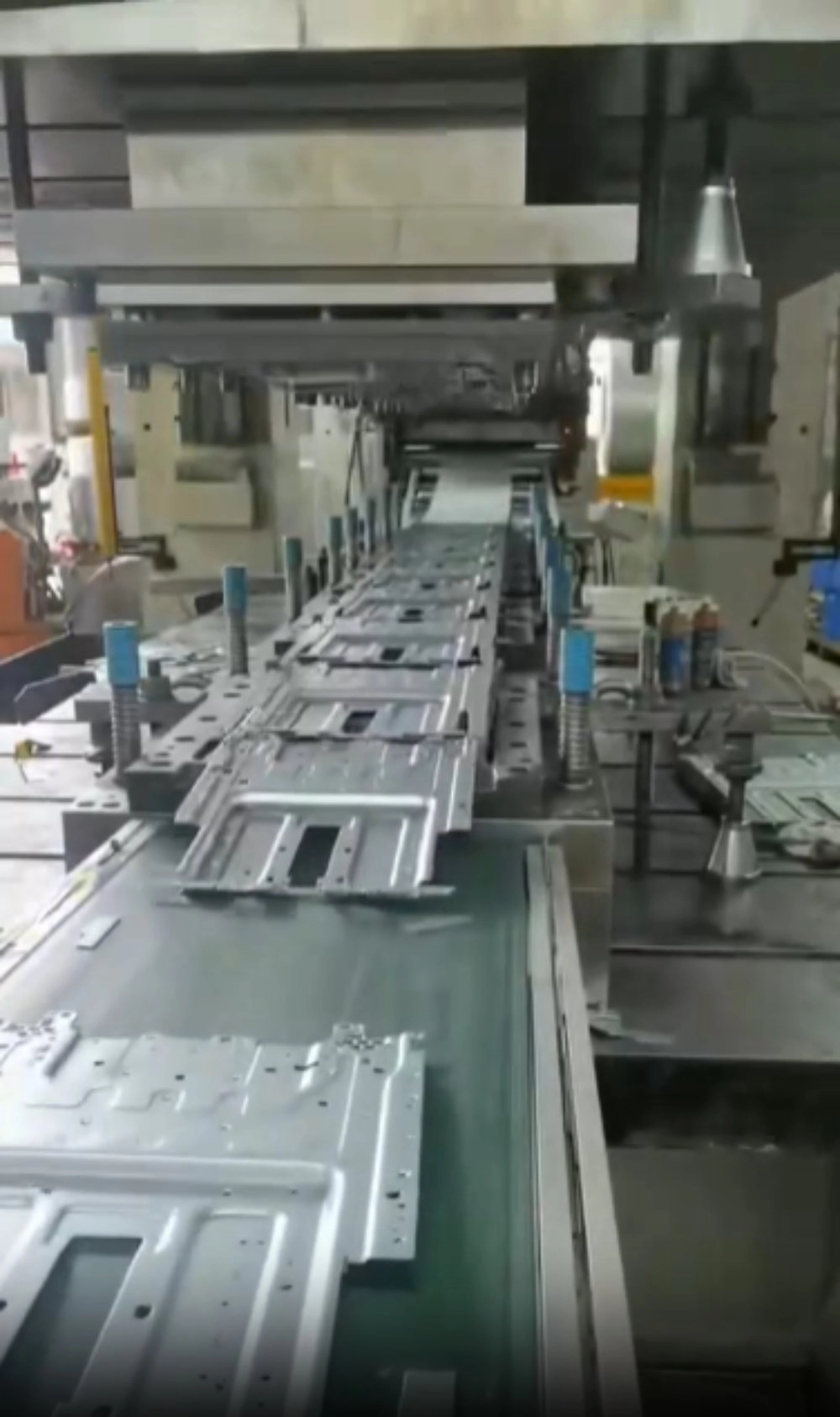
Progressive die stamping is a precision metal forming process in which a continuous strip of metal passes through a series of stations inside a specially designed die. Each station performs one or more operations such as punching, blanking, bending, embossing, coining, or forming. With every press stroke, the strip advances to the next station until a fully finished part is produced.
Unlike single-operation stamping, progressive die stamping integrates multiple manufacturing steps into one automated production cycle. This significantly reduces handling time while maintaining dimensional consistency throughout mass production.
The process is particularly suitable for manufacturing:
· Precision brackets
· Compressor accessories
· Electrical connectors
· Industrial clips
· Pneumatic equipment parts
· Precision shims
· Pressure shells
· Sheet metal hardware
Large-scale manufacturing requires more than simply producing parts quickly. Manufacturers must ensure:
· Consistent dimensional accuracy
· Stable production quality
· Low material waste
· High equipment utilization
· Reliable delivery schedules
Progressive die stamping addresses all these challenges by combining automation, precision tooling, and continuous production.
For companies producing thousands or even millions of components annually, it offers significant operational advantages over traditional fabrication methods.
One of the biggest advantages of progressive die stamping is production speed.
Since every press stroke completes multiple operations simultaneously, manufacturers avoid moving parts between separate machines. This streamlined workflow dramatically increases throughput.
Instead of performing:
· Cutting
· Punching
· Bending
· Forming
as separate processes, everything happens inside one progressive die.
Modern automatic stamping lines equipped with precision presses ranging from 63T to 315T can maintain stable production over extended manufacturing cycles while minimizing operator intervention.
This makes progressive die stamping ideal for continuous production programs.
For OEM manufacturers, consistency is often more important than speed.
Every component must fit perfectly during assembly, especially in industries like automotive, compressors, industrial machinery, and pneumatic systems.
A properly designed progressive die produces nearly identical parts throughout the entire production run.
Typical capabilities include:
· Stamping tolerance of ±0.008–0.03 mm
· Flatness up to ≤0.02 mm
· Stable forming dimensions
· Excellent repeatability
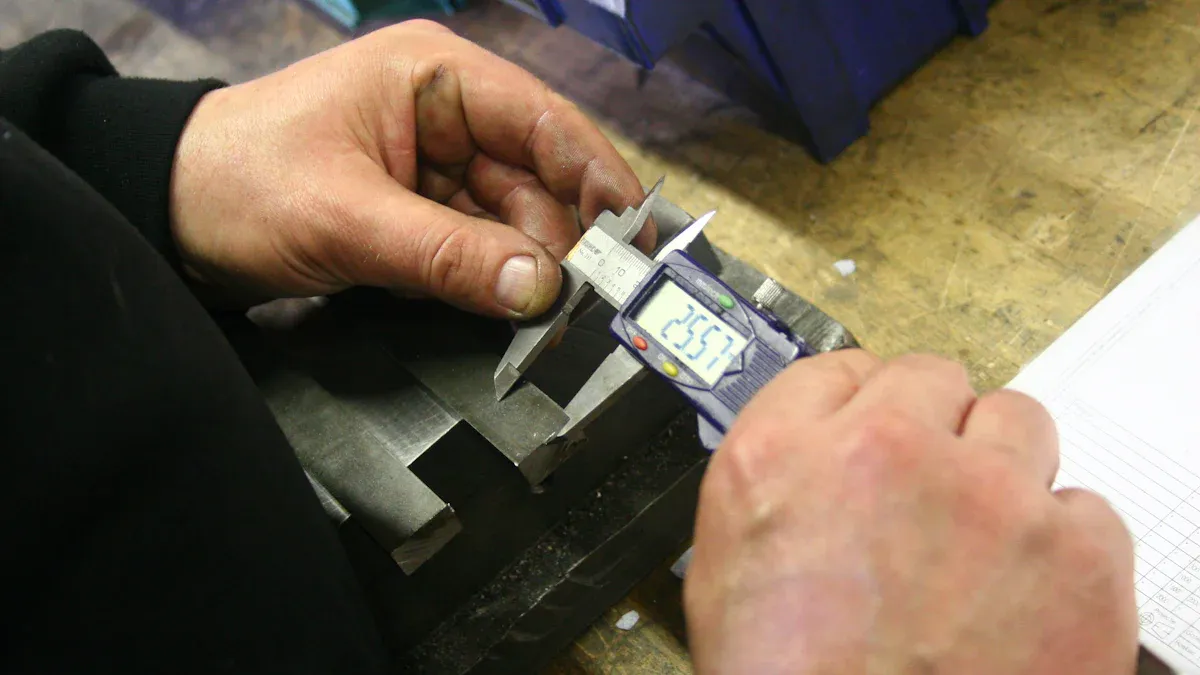
Critical dimensions can also undergo 100% inspection using Coordinate Measuring Machines (CMM), ensuring every batch meets engineering requirements.
Although progressive die tooling requires upfront engineering, it becomes highly economical during mass production.
The savings come from several areas:
Automation minimizes manual handling.
Multiple manufacturing steps occur in one press cycle.
Optimized strip layouts improve material utilization.
Higher output lowers manufacturing cost per component.
These efficiencies make progressive die stamping one of the most cost-effective solutions for long-term production programs.
Material costs account for a significant portion of total manufacturing expenses.
Progressive die tooling is carefully designed to maximize sheet utilization while reducing unnecessary scrap.
Common processable materials include:
· Cold rolled steel
· Galvanized steel
· 304 stainless steel
· 316 stainless steel
· Aluminum
· Copper
· Special deep drawing steel
For every production batch, manufacturers can also provide material spectrum test reports and complete traceability documentation to ensure quality control.
Many industrial parts require multiple forming features, including:
· Holes
· Slots
· Tabs
· Bends
· Embossing
· Formed edges
Instead of producing these features separately, progressive die stamping completes them in sequence.
This allows manufacturers to produce highly complex sheet metal components while maintaining tight tolerances.
For products requiring deep cavities or shell structures, progressive tooling can also be combined with deep drawing stamping technology to manufacture pressure shells, housings, and structural components efficiently.
Today's manufacturers rarely produce only standard parts.
Many projects involve:
· New product development
· Import part replacement
· Prototype optimization
· Non-standard components
A capable supplier should support complete customization through:
· 2D CAD drawings
· STEP files
· IGS files
· SolidWorks models
· Reverse engineering from physical samples
Engineering teams can also perform Design for Manufacturability (DFM) reviews to simplify production while reducing manufacturing costs without affecting product performance.
At companies such as Shanghai Hehua Machinery Technology Co., Ltd., customers can receive one-stop OEM and ODM services covering mold design, sampling, mass production, CNC machining, welding, and comprehensive surface finishing, helping shorten development cycles for new products.
Maintaining consistent quality over thousands or millions of parts is one of the biggest challenges in metal manufacturing.
Progressive die stamping addresses this through precision tooling, automated feeding systems, and standardized production processes. Once the die has been properly validated, each press stroke repeats the same sequence of operations, minimizing variation between parts.
To further ensure product quality, professional manufacturers implement comprehensive inspection procedures, including:
· First Article Inspection (FAI)
· In-process quality monitoring
· Coordinate Measuring Machine (CMM) inspection
· 100% inspection of critical dimensions
· Complete inspection reports
· Material traceability throughout production
These quality control measures are especially important for industries where dimensional accuracy directly affects assembly performance and product reliability.
Once a progressive die has been developed and approved, future production can begin with minimal preparation.
Compared with processes that require frequent fixture changes or repeated setup, progressive die stamping significantly reduces production downtime.
For long-term OEM projects, this means:
· Faster production scheduling
· Stable delivery performance
· Simplified inventory planning
· Better responsiveness to market demand
Manufacturers that operate their own tooling workshops can further improve delivery efficiency by handling mold maintenance and repairs in-house rather than relying on third-party suppliers.
Product development rarely starts with large production volumes. Most projects progress from prototype verification to pilot production before reaching full-scale manufacturing.
A reliable stamping partner should be able to support every stage of this process.
Typical capabilities include:
· Rapid prototype development
· 7-day fast sampling for qualified projects
· Tool optimization after testing
· Small trial orders
· Medium-volume production
· Annual high-volume manufacturing programs
This scalable approach helps engineers validate product designs while reducing development risks before committing to mass production.
Managing multiple suppliers for stamping, machining, welding, and surface treatment often increases lead times and communication complexity.
A one-stop manufacturing partner can simplify the entire production process by integrating complementary services under one roof.
Comprehensive services typically include:
· Progressive die stamping
· Deep drawing stamping
· Precision punching
· Thick plate forming
· CNC machining
· Welding and assembly
· Surface treatment
· Final inspection
· Export packaging
This integrated manufacturing model reduces logistics costs, shortens production cycles, and ensures consistent quality across every stage of production.
Because of its combination of speed, precision, and repeatability, progressive die stamping is widely used across many industrial sectors.
Typical applications include:
· Automotive components
· Rail transit equipment
· Aerospace hardware
· Wind power equipment
· New energy equipment
· Industrial machinery
· Compressor accessories
· Pneumatic equipment
· Semiconductor equipment components
· Construction machinery hardware
Many of these industries require strict compliance with international quality standards and long-term production stability, making progressive die stamping an ideal manufacturing solution.
Selecting the right supplier is just as important as selecting the manufacturing process itself.
When evaluating a progressive die stamping manufacturer, buyers should consider several key factors:
Look for companies with extensive experience serving demanding industries such as automotive, industrial machinery, aerospace, and energy equipment.
An internal mold workshop enables faster tooling development, maintenance, engineering changes, and better control over production quality.
Advanced automatic stamping lines and precision presses help ensure stable production and consistent part quality.
Manufacturers offering DFM analysis, engineering consultation, and drawing optimization can help reduce manufacturing complexity and improve product performance.
International certifications demonstrate a commitment to quality management and process control.
For example, Shanghai Hehua Machinery Technology Co., Ltd., established in 2005 with its subsidiary Hehua Machinery Technology (Kunshan) Co., Ltd. founded in 2018, operates a manufacturing facility covering more than 17,800 square meters with over 160 employees. The company serves high-end equipment manufacturers in automotive, rail transit, aerospace, wind power, nuclear power, semiconductor equipment, industrial machinery, and new energy industries.
Its manufacturing system is supported by internationally recognized certifications, including ISO 9001, IATF 16949, EN 15085, and EN 9606-1, reflecting a strong commitment to quality management and precision manufacturing throughout every stage of production.
For manufacturers producing large quantities of precision metal components, Progressive Die Stamping offers a practical combination of productivity, accuracy, material efficiency, and long-term manufacturing stability. By integrating multiple forming operations into a single automated process, it reduces production complexity while delivering the repeatability required for demanding industrial applications.
Whether you need compressor accessories, industrial brackets, pressure shells, precision shims, or custom sheet metal components, partnering with an experienced manufacturer with in-house tooling, advanced stamping equipment, and comprehensive engineering support can help streamline product development and ensure consistent results from prototype through mass production.
As global manufacturing continues to prioritize efficiency, quality, and supply chain reliability, progressive die stamping remains one of the most effective solutions for producing high-volume metal parts with confidence.


 AddressNo. 66 Xingpu Road, Lujia Town,Kunshan City, Factory Buildings 3 and 4
  en
en
 English
 繁体中文
繁体中文 Italian
 Spanish
 Japanese
 Portuguese
 Korean
 Russian
 French
 German
 Estonian
 Arabic
 Indonesian


 Message