For manufacturers producing metal assemblies in repeated batches, welding consistency is not simply a quality target. It directly affects dimensional accuracy, assembly performance, rework rates, production scheduling, and the service life of finished equipment. As production volumes increase, maintaining the same weld quality across thousands of parts becomes increasingly difficult with manual operations alone.
This is where Robot Welding provides a practical solution. By combining automated welding cells with controlled welding parameters, dedicated fixtures, in-process inspection, and post-weld correction, manufacturers can achieve more repeatable results across high-volume metal fabrication projects.
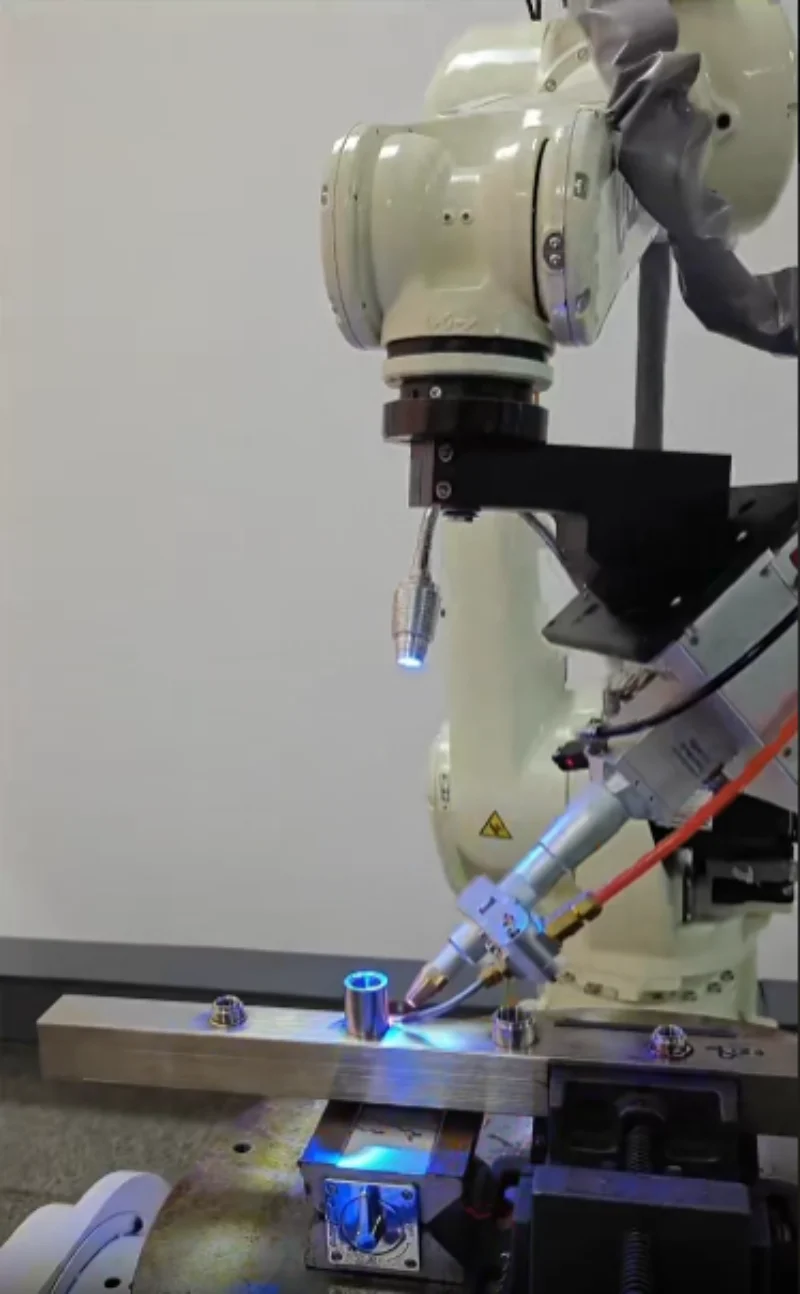
A welded component may look simple from the outside, but its final quality depends on several factors. Welding heat can cause deformation, inconsistent welding speed can affect bead appearance, and variations in part positioning can change the location or penetration of a weld. When these variations are repeated across a large batch, even small differences can create assembly problems.
For industrial equipment frames, brackets, housings, pressure-related assemblies, and other structural weldments, consistent dimensions are particularly important. A component that is slightly distorted may require additional straightening or rework before it can be assembled.
Robotic welding helps control these variables by following a programmed welding path and maintaining repeatable operating conditions. This makes it particularly suitable for standardized parts and recurring production orders where the same welding operations need to be performed many times.
One of the main advantages of Robot Welding is its ability to repeat programmed welding movements with a high degree of consistency. Once the welding process, fixture position, travel path, and relevant parameters have been established, the same production sequence can be applied across a large batch.
This is valuable for components such as compressor frames, equipment bases, construction machinery brackets, and standardized structural weldments. Instead of relying entirely on individual operator technique, automated welding cells provide a more controlled production method.
However, robotic welding is not a replacement for proper process engineering. The quality of the finished assembly still depends on material preparation, fixture design, welding process selection, joint configuration, and post-weld treatment. For this reason, Hehua combines automated welding with other manufacturing capabilities rather than treating robotic welding as an isolated process.
Different metal components require different welding approaches. Depending on plate thickness, material, joint structure, load requirements, and appearance requirements, the appropriate process may be MIG/MAG welding, TIG welding, spot welding, fillet welding, submerged arc welding, brazing, or robotic automatic welding.
The material range can include carbon steel, galvanized steel, 304 and 316 stainless steel, aluminum alloys, cast iron, ductile iron, and copper alloys. Dissimilar metal welding can also be considered when the application requires it.
For high-volume standardized assemblies, robotic welding can provide significant advantages when the component geometry and welding sequence are suitable for automation. For more complex or lower-volume components, manual or other welding processes may be more appropriate. Selecting the process according to the actual part requirements helps avoid unnecessary automation while maintaining the required quality.
Fixtures Are Critical to Robotic Welding Accuracy
A robotic welding system can only achieve consistent results when the workpiece is positioned consistently. Welding fixtures therefore play an important role in automated production.
A properly designed fixture keeps components in the correct position during welding and helps reduce movement caused by thermal expansion. For custom OEM projects, fixture fabrication can be integrated into the manufacturing process based on customer drawings, samples, or existing components.
At Hehua Machinery Technology (Kunshan) Co., Ltd., the welding process can be combined with fixture fabrication, blanking, welding, straightening, CNC secondary machining, and surface finishing. This one-stop approach allows the manufacturing team to evaluate the complete production process rather than focusing only on the welding operation.
Welding consistency does not mean that thermal deformation can be completely eliminated. Metal expands and contracts when exposed to welding heat, and the resulting deformation depends on material, thickness, joint design, welding sequence, and heat input.
For this reason, Hehua incorporates post-weld straightening into its manufacturing process. The company provides welding DFM optimization during the engineering stage to identify potential deformation and cracking risks before production. After welding, components can undergo straightening and dimensional inspection to bring them within the specified requirements.
The available overall dimensional tolerance is approximately ±0.1 to ±0.3 mm depending on the component and process, while flatness after straightening can reach ≤0.03 mm/100 mm for applicable parts. These capabilities are particularly relevant to equipment bases, mounting brackets, structural frames, and other assemblies that require controlled dimensions for subsequent installation.
Consistent welding is not determined only by visual appearance. Industrial welded assemblies may require dimensional inspection, material verification, non-destructive testing, pressure testing, or air tightness testing depending on their intended application.
Hehua's quality control process includes incoming material inspection, in-process patrol inspection, post-weld straightening checks, and first-article dimensional inspection. For critical welds, magnetic particle testing, ultrasonic testing, and hydrostatic testing are available.
Pressure-related welded assemblies can also undergo air and water tightness testing. For pressure parts, 100% air tightness testing can be applied according to project requirements. Inspection reports and relevant test documentation can be provided with shipments.
This approach helps ensure that quality control is applied throughout production rather than only at the final inspection stage.
High-volume production often starts with a prototype or small batch. Before committing to larger quantities, manufacturers need to confirm that the part design, welding sequence, fixture, and inspection requirements work together.
Hehua supports OEM and ODM welding projects based on 2D CAD drawings, 3D STEP, IGS, SolidWorks, and UG files. Reverse engineering from physical samples is also available for projects involving legacy weldments, replacement components, or imported assemblies that need to be reproduced locally.
For suitable projects, sampling can be completed within 3–7 days. A dedicated engineer supports technical communication and reviews the drawing before production. This provides an opportunity to identify welding deformation risks and make design improvements before the process is transferred to larger production volumes.
For industrial customers, welding is often only one stage of the manufacturing process. A welded assembly may require cutting, stamping, CNC machining, grinding, straightening, surface treatment, and final inspection before it is ready for installation.
Hehua integrates these capabilities into an end-to-end manufacturing service. Post-weld surface treatment can include shot blasting, black oxide, electrophoresis, Dacromet, powder coating, galvanization, anodizing, and polishing, depending on the material and application.
This is useful for outdoor equipment, corrosion-resistant assemblies, equipment frames, sheet metal housings, and structural components that require both mechanical strength and a suitable finished surface.
Automation is most effective when it is supported by a stable manufacturing system. Hehua operates manual welding stations together with automatic robotic welding cells and supporting cutting, straightening, and polishing workshops. Its monthly production capacity can reach up to 30,000 sets for applicable products.
Standard orders can generally be delivered within 12–25 days, with priority scheduling available for urgent requirements. The company also supports small-batch prototypes, recurring bulk orders, and overseas equipment spare parts.
With more than 17,800 square meters of plant area and over 160 employees, Hehua Machinery Technology (Kunshan) Co., Ltd. provides metal manufacturing services for automotive, rail transit, aerospace, wind power, nuclear power, industrial machinery, semiconductor equipment, new energy equipment, and other high-end equipment manufacturing applications.
High-volume welding quality depends on more than installing a robotic welding machine. Consistency comes from combining suitable materials, reliable fixtures, controlled welding parameters, engineering review, post-weld straightening, dimensional inspection, and appropriate testing.
For manufacturers with recurring production requirements, Robot Welding can provide a more stable and repeatable production method when the part design and order volume are suitable for automation. Combined with OEM/ODM engineering support and downstream machining and finishing capabilities, it can become part of a complete manufacturing process rather than a standalone welding operation.
For industrial equipment manufacturers looking for repeatable welded assemblies, Robot Welding offers a practical way to improve production consistency while maintaining control over quality, dimensional accuracy, and delivery requirements.


 AddressNo. 66 Xingpu Road, Lujia Town,Kunshan City, Factory Buildings 3 and 4
  en
en
 English
 繁体中文
繁体中文 Italian
 Spanish
 Japanese
 Portuguese
 Korean
 Russian
 French
 German
 Estonian
 Arabic
 Indonesian


 Message