When OEM buyers evaluate stamping suppliers, the conversation often starts with capacity, price, and lead time. But in real projects, those are rarely the factors that decide whether cooperation will run smoothly. What matters more is whether the factory can hold dimensions consistently, manage tooling well, respond to production changes, and support stable mass production without creating quality or delivery risk.
For OEM parts, progressive die stamping is often chosen because it can solve several manufacturing problems at once. It is suitable for high-speed, high-volume production, supports complex part structures, maintains good dimensional consistency, and reduces material waste when the die layout is designed properly. For parts that need punching, flanging, drawing, shaping, or multiple features in one process flow, Progressive Die Stamping is often more efficient than relying on multiple separate operations.
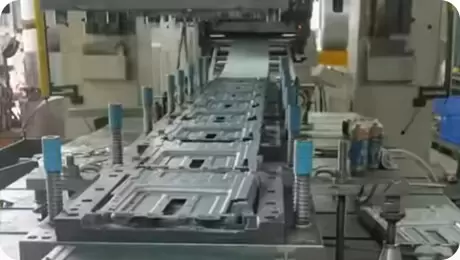
That said, not every stamping supplier is equally prepared for OEM work. A supplier may have presses and operators, but still lack the tooling, process control, automation, or traceability needed for a serious program. If you are sourcing OEM metal parts, here are the main points worth checking before selecting a progressive die stamping factory.
A good supplier should first be able to explain whether progressive die stamping is truly the right process for your part. This sounds basic, but it matters. Some parts are suitable for high-speed progressive stamping, while others may need transfer dies, composite tooling, or a combination of stamping and secondary operations.
A factory with solid engineering support will usually review:
If a supplier only says “yes, we can make it” without discussing these points, that is often a warning sign. OEM projects need process judgment, not just machine availability.
For example, progressive die stamping becomes especially valuable when the part needs multiple stations in one continuous process, such as punching, forming, flanging, deep drawing, shaping, tapping, or stacking. In those cases, one properly designed die line can replace several disconnected operations and reduce handling, variation, and overall cycle cost.
Many suppliers list press tonnage, but OEM buyers should look deeper than maximum capacity. Press range matters, but so do feeding accuracy, die size, speed stability, changeover time, and batch flexibility.
A factory prepared for OEM stamping should be able to discuss capability in practical terms, such as:
This matters because OEM projects rarely stay fixed forever. There may be pilot runs, engineering changes, annual demand fluctuations, or urgent replenishment requirements. A supplier that can only run one fixed volume efficiently may become difficult to work with later.
In a stronger stamping setup, you want to see not only large presses for bigger structural parts, but also high-speed machines for precision parts and smaller components. That mix is often a sign that the factory understands different production scenarios instead of relying on one generic process.
For progressive die stamping, the die is the process. If the die design is weak, production problems will continue no matter how advanced the press line looks.
This is why OEM buyers should ask more about tooling than most suppliers expect. A serious factory should be able to explain:
In practice, tooling capability directly affects dimensional stability, burr performance, material utilization, and long-term cost control. It also affects how quickly the factory can respond when design updates happen.
If the supplier has in-house die design and development capability, that usually improves communication speed and engineering response. It becomes easier to solve issues like springback, cracking, insufficient forming, or unstable feeding before they turn into repeated mass-production defects.
For OEM stamped parts, one good sample is not enough. The question is whether the supplier can hold the same quality across thousands or millions of pieces.
That means you should ask how the factory controls:
A stronger stamping supplier will talk about process control in measurable terms, not general claims. They should also explain what happens during first-piece inspection, in-process inspection, and end-of-batch confirmation.
For precision stamped parts, consistency often matters more than maximum speed. High-speed output is only useful when the result is stable enough for direct assembly. If a supplier still requires frequent manual sorting, secondary correction, or heavy rework, the apparent production advantage disappears quickly.
Many OEM buyers focus heavily on dimensions and forget surface quality until late in the project. But for parts made from cold rolled sheet, galvanized material, coated sheet, stainless steel, or non-ferrous alloys, surface control can be just as important as geometry.
A good progressive stamping factory should be able to manage:
This becomes especially important for covers, housings, shielding parts, visible brackets, and parts that go directly into downstream coating or assembly. Once surface damage appears in volume production, sorting and rework can become expensive very quickly.
Another good indicator is whether the supplier can talk about real project types rather than vague categories.
A capable progressive die stamping factory should be comfortable discussing applications such as:
The reason this matters is simple: different parts bring different production risks. A motor core project may focus on burr control, stacking accuracy, and magnetic performance. A door hinge may depend more on forming repeatability and hole position. A shielding cover may require fine features, clean edges, and stable high-speed production.
When a supplier has actual experience in comparable applications, the communication is usually more practical and the risk is lower.
For OEM programs, stable output is rarely achieved through manual effort alone. Automation helps reduce operator dependency, improve repeatability, and increase line efficiency.
Useful questions include:
These points are especially important when the program involves multiple SKUs, frequent scheduling changes, or larger annual demand. A supplier with faster changeover and better automation usually handles production planning more smoothly.
This also affects responsiveness. If a customer suddenly needs a volume increase or an urgent batch, a factory with poor changeover efficiency may struggle even if its nominal equipment list looks strong.
Traceability is one of the clearest differences between a general job shop and an OEM-ready factory.
For OEM stamping, buyers should confirm whether the supplier can trace each batch back to:
A supplier with structured traceability can react faster when a problem appears and provide more confidence during audits or customer complaint handling. Without that system, even a small issue can become difficult to investigate.
Factories that use MES, QR code management, visual engraving, or digital inspection upload generally have a stronger foundation for repeat business, especially in automotive and equipment-related projects.
Certifications should not be the only reason to choose a stamping supplier, but they are still important. For OEM parts, especially in automotive or transport-related industries, quality system certifications often reflect how disciplined the factory is in documentation, control, and execution.
Hehua Machinery, for example, has passed IATF 16949, ISO 9001, and relevant welding-related certifications, and this kind of system foundation is important for supporting demanding industrial customers. But what matters most is that those systems are connected to real process practice, including inspection plans, traceability, tooling management, and production response.
When choosing a progressive die stamping factory for OEM parts, the real question is not just whether the supplier can stamp the part. The real question is whether they can support the full life of the project with stable tooling, repeatable precision, controlled quality, practical engineering communication, and production discipline.
A good supplier should be able to help you reduce risk, not create more hidden problems after SOP. That means looking beyond a press list and asking how the factory handles tooling, automation, traceability, dimensional stability, and long-run production control.
If those fundamentals are in place, progressive die stamping can become a highly efficient solution for OEM metal parts, especially where volume, consistency, and integrated forming are critical.


 AddressNo. 66 Xingpu Road, Lujia Town,Kunshan City, Factory Buildings 3 and 4
  en
en
 English
 繁体中文
繁体中文 Italian
 Spanish
 Japanese
 Portuguese
 Korean
 Russian
 French
 German
 Estonian
 Arabic
 Indonesian


 Message