Stainless steel and aluminum are widely used in industrial equipment because they offer different combinations of corrosion resistance, strength, weight, and service life. However, welding these materials requires appropriate process control. Heat input, joint design, material thickness, surface condition, and post-weld treatment can all affect the finished assembly.
For manufacturers producing custom equipment components, TIG Welding is a practical process when controlled welding, clean welds, and dimensional consistency are important. TIG, also known as Gas Tungsten Arc Welding (GTAW), uses a non-consumable tungsten electrode and shielding gas to create a controlled arc.
The process is particularly relevant to stainless steel and aluminum components used in equipment housings, brackets, structural assemblies, and other custom metal parts. The right welding process, however, should always be selected according to the material, thickness, joint structure, production volume, and required finish.
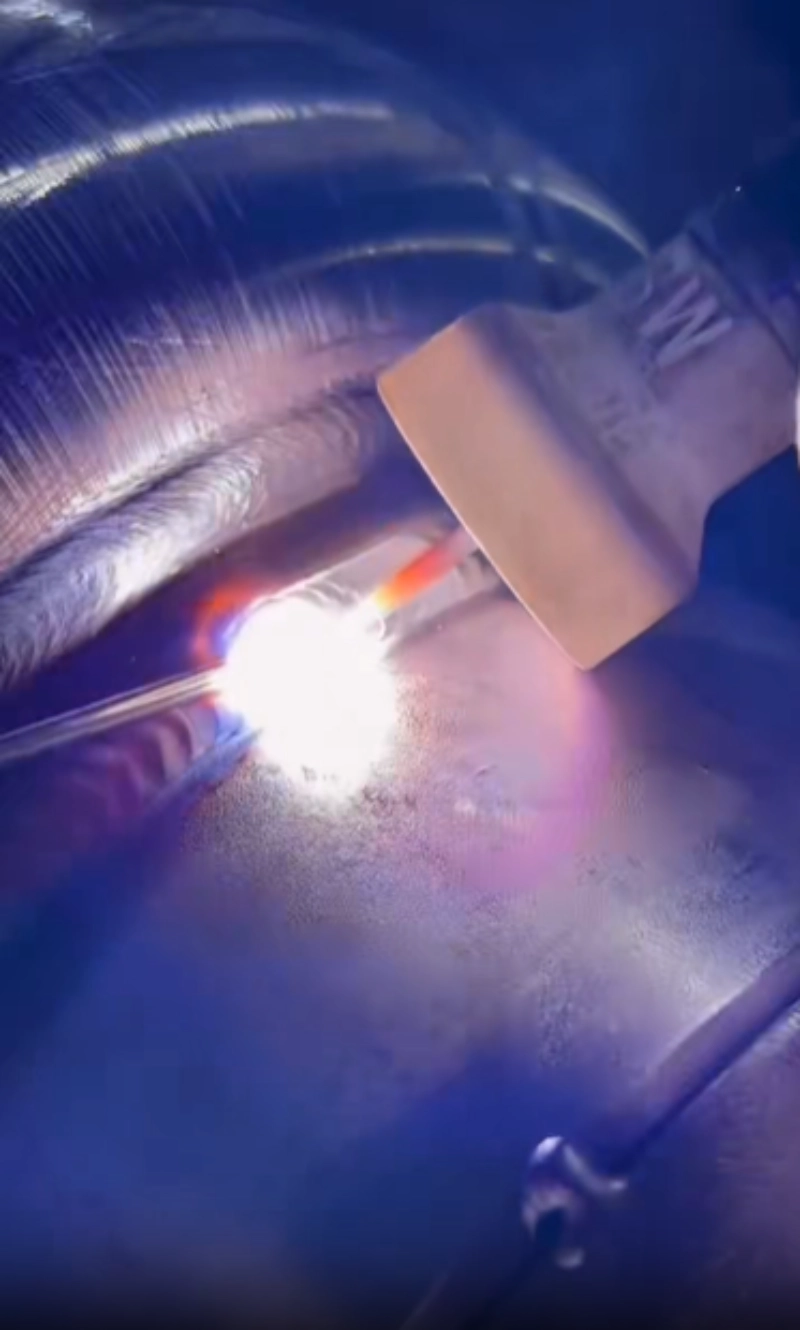
Stainless steel is frequently selected for industrial components where corrosion resistance and surface quality are important. Common applications include equipment enclosures, fluid-handling components, brackets, machine housings, and exposed structural parts.
One of the main advantages of TIG Welding for stainless steel is the level of control available during welding. When the process is properly matched to the material and joint design, manufacturers can manage heat input and weld appearance more effectively.
This is important because excessive heat can contribute to distortion and affect the appearance of stainless steel surfaces. For precision components, deformation can also change mounting dimensions and increase the amount of post-weld correction required.
Hehua provides TIG welding for 304 and 316 stainless steel, among other weldable metals. The welding process is selected according to the component's material, thickness, structural requirements, and appearance requirements rather than applying one process to every stainless steel part.
Stainless steel TIG welding can be used for a range of industrial assemblies.
Typical applications include:
· Stainless steel equipment housings
· Machine brackets and mounting components
· Fluid equipment assemblies
· Precision structural components
· Corrosion-resistant enclosures
· Industrial equipment frames
· Selected pressure-related welded assemblies
For equipment housings that remain visible after installation, weld appearance may be an important consideration. In these cases, TIG can be combined with post-weld grinding and polishing to achieve the required surface condition.
For pressure-related assemblies, appearance alone is not sufficient. Weld integrity and leakage performance must also be verified. Hehua can provide air and water tightness testing for applicable pressure parts, with additional NDT options available for critical welded assemblies.
Aluminum presents different welding challenges from stainless steel. Its thermal characteristics and surface oxide layer require appropriate preparation and welding parameters.
Aluminum is widely used when manufacturers need to reduce component weight while maintaining suitable structural performance. It can therefore be found in equipment structures, lightweight housings, brackets, frames, and other industrial components.
TIG Welding can be used for aluminum alloy components where controlled welding is required. The process needs to be matched to the alloy, material thickness, joint design, and production requirements.
For OEM projects, the welding process should be considered during the design stage. Joint accessibility, fixture positioning, weld sequence, and expected thermal deformation can all affect the final result.
This is why Hehua provides welding DFM optimization as part of its custom OEM and ODM service. Engineers can review customer drawings and identify potential welding deformation or cracking risks before production begins.
Although both stainless steel and aluminum can be welded using TIG, they should not be treated as identical materials.
Stainless steel generally requires careful control of heat input to limit distortion and preserve the desired surface condition. Aluminum requires attention to its thermal behavior and oxide layer, while the selected alloy and thickness also influence the welding parameters.
The joint structure is another important factor.
A thin sheet metal enclosure may require a different approach from a thick load-bearing bracket. Similarly, a visible decorative component may prioritize weld appearance, while a pressure assembly may prioritize weld integrity and leak resistance.
Hehua's welding capability covers carbon steel, galvanized steel, 304/316 stainless steel, aluminum alloy, cast iron, ductile iron, and copper alloy. Dissimilar metal welding is also available for suitable projects.
This broader material capability allows the production team to evaluate the complete assembly instead of looking at TIG welding as an isolated operation.
Welding distortion is one of the most important practical concerns for precision metal assemblies.
As the welded area heats and cools, the material expands and contracts. If the heat distribution is uneven, the finished component can move away from its original drawing dimensions.
For stainless steel and aluminum parts with tight dimensional requirements, distortion control should start before welding.
Hehua can provide fixture fabrication, welding sequence optimization, and DFM review to help reduce deformation. After welding, components can also undergo straightening when required.
For applicable projects, the company specifies overall dimensional tolerances of approximately ±0.1–±0.3 mm, while flatness can reach ≤0.03 mm/100 mm after straightening.
The achievable result depends on the component structure, material, thickness, and drawing requirements, but establishing dimensional targets before production provides a clear basis for inspection.
TIG welding offers useful advantages, but it is not necessarily the most efficient process for every stainless steel or aluminum component.
For high-volume production or thicker structural assemblies, MIG/MAG welding may provide higher productivity. Robotic welding can be advantageous for standardized parts manufactured in large quantities. Spot welding can be suitable for certain sheet metal structures.
Hehua provides multiple welding processes, including MIG/MAG, TIG, spot welding, fillet welding, submerged arc welding, brazing, and robotic automatic welding.
The practical objective is to match the welding method to the part.
For example, a precision stainless steel enclosure with visible welds may require a different process strategy from a large aluminum structural frame produced repeatedly in high volumes.
The welding operation is often only one stage in the production of a finished industrial component.
After welding, stainless steel and aluminum parts may require grinding, straightening, polishing, or other finishing operations. Depending on the material and application, additional surface treatment may be required.
Hehua provides post-weld services including grinding, straightening, shot blasting, black oxide, electrophoresis, Dacromet, powder coating, galvanization, anodizing, and polishing.
For stainless steel components where appearance and corrosion resistance are important, grinding and polishing can be used according to the required finish.
For aluminum components, anodizing can be considered where the application requires a particular surface condition. Other finishing processes can be selected according to the substrate and final operating environment.
This one-stop approach reduces the need to transfer welded components between multiple suppliers.
A reliable welded assembly requires more than visual inspection.
Hehua's quality control process includes incoming material inspection, in-process patrol inspection, post-weld straightening checks, and dimensional inspection.
For first articles, full dimensional inspection can be performed. Batch production can then be controlled through periodic inspections according to the project requirements.
Welds are checked for common defects such as porosity, slag inclusion, and cracks. For critical pressure welds, magnetic particle testing, ultrasonic testing, hydrostatic testing, and air tightness testing are available.
Material test certificates and material traceability can also be provided for applicable projects.
These controls are particularly relevant when stainless steel and aluminum assemblies are integrated into equipment used in automotive, rail transit, aerospace, industrial machinery, or other demanding applications.
Many stainless steel and aluminum welding projects begin with a customer drawing rather than a standard product.
Hehua supports 2D CAD and 3D formats including STEP, IGS, SolidWorks, and UG. The company also supports reverse engineering from physical samples and reproduction of legacy welded components.
During drawing review, engineers can assess welding access, potential deformation, joint design, and cracking risks before production.
For new projects, this can help identify manufacturing issues early rather than discovering them after the first batch has already been produced.
Hehua supports prototype and small-batch orders as well as mass production. Applicable samples can be completed within 3–7 days, while standard production orders generally have a 12–25 day delivery period depending on project requirements.
Hehua Machinery Technology (Kunshan) Co., Ltd. was established in 2018 as a subsidiary of Shanghai Hehua Machinery Technology Co., Ltd., which was founded in 2005.
The company specializes in key metal components for automotive, rail transit, aerospace, wind power, nuclear power, industrial machinery, semiconductor equipment, and new energy equipment.
Its manufacturing facility covers more than 17,800 square meters and employs more than 160 people. Hehua has independent import and export rights and can provide services covering production and export.
The company has obtained ISO 9001, IATF 16949, and EN 15085 certifications. Its qualified welders hold EN ISO 9606-1 certification, supporting welding projects where formal process and personnel qualifications are required.
For overseas OEM customers, this combination of welding, CNC machining, finishing, inspection, and project management provides a single manufacturing resource for complex metal assemblies.
The decision to use TIG welding for stainless steel or aluminum should be based on the actual requirements of the part.
If the assembly requires controlled welding, clean weld appearance, accurate dimensions, or specific material compatibility, TIG can be an effective option. If the priority is maximum production speed for standardized high-volume components, another welding process may be more appropriate.
For this reason, experienced OEM manufacturing begins with the drawing, material, thickness, joint structure, production volume, and final application.
TIG Welding can then be selected as part of a complete manufacturing process that includes fixture preparation, welding, straightening, machining, inspection, and surface finishing.
For stainless steel and aluminum components where weld quality and dimensional consistency matter, this process-based approach is more reliable than choosing a welding method based on material name alone.
Stainless steel and aluminum offer important advantages for industrial equipment, but their different welding characteristics require appropriate process control.
TIG Welding provides a controlled welding option for suitable stainless steel and aluminum assemblies, particularly where weld appearance, dimensional accuracy, and process stability are important.
From drawing review and fixture fabrication to welding, straightening, CNC secondary machining, inspection, and surface treatment, Hehua Machinery Technology (Kunshan) Co., Ltd. can support OEM customers through the complete production workflow.
For manufacturers sourcing custom stainless steel or aluminum welded components, evaluating the material, joint design, production volume, dimensional requirements, inspection standards, and finishing requirements together is the most practical way to determine whether TIG is the right process.


 AddressNo. 66 Xingpu Road, Lujia Town,Kunshan City, Factory Buildings 3 and 4
  en
en
 English
 繁体中文
繁体中文 Italian
 Spanish
 Japanese
 Portuguese
 Korean
 Russian
 French
 German
 Estonian
 Arabic
 Indonesian


 Message