Finding a reliable partner for tight-tolerance parts is hard for many buyers. You need more than a fast quote. You need a careful check of equipment, quality systems, engineering skills, and communication.
A professional CNC machining company in China can save you substantial costs without losing precision. You just need to know what to look at. This guide gives you a practical checklist for your search.
Leading suppliers show the standards you should look for. Their advanced CNC lathes and machining centers can hold tolerances of ±0.005 mm. Their quality systems check every production batch.
You can get great manufacturing at a fair cost. You just need the right way to evaluate. Let's see what makes great suppliers different from average ones.
Pick a CNC partner that has modern machines and can hold tight tolerances.
Check that the company has quality certifications and its own inspection tools, so you can trust the parts you get.
Use feedback from engineers to make designs better and lower production costs.
Make sure you talk clearly and keep your designs safe with agreements.
Look at past projects and delivery times to check the supplier's history of good work.
When your parts need tight tolerances, start by checking the physical assets. Advanced CNC machines are the backbone of precision manufacturing. A professional cnc machining company invests in modern equipment to deliver consistent results. You need a partner who understands the demands of precision parts production.
Look for a shop with multi-axis CNC lathes and milling machines. These machines allow complex operations in a single setup. This reduces errors from moving parts between machines. 5-axis machines can improve accuracy by reducing multiple setups. They allow continuous machining from different angles. This reduces the risk of misalignment.
A reliable cnc machining company guarantees tolerances of ±0.005 mm or better. State-of-the-art equipment meets these standards. CNC turning achieves precision within ±0.025 mm. Milling operations hold ±0.025–0.051 mm. For demanding custom cnc machined parts, this level of accuracy matters.
The chart below shows typical tolerance ranges for advanced CNC operations.
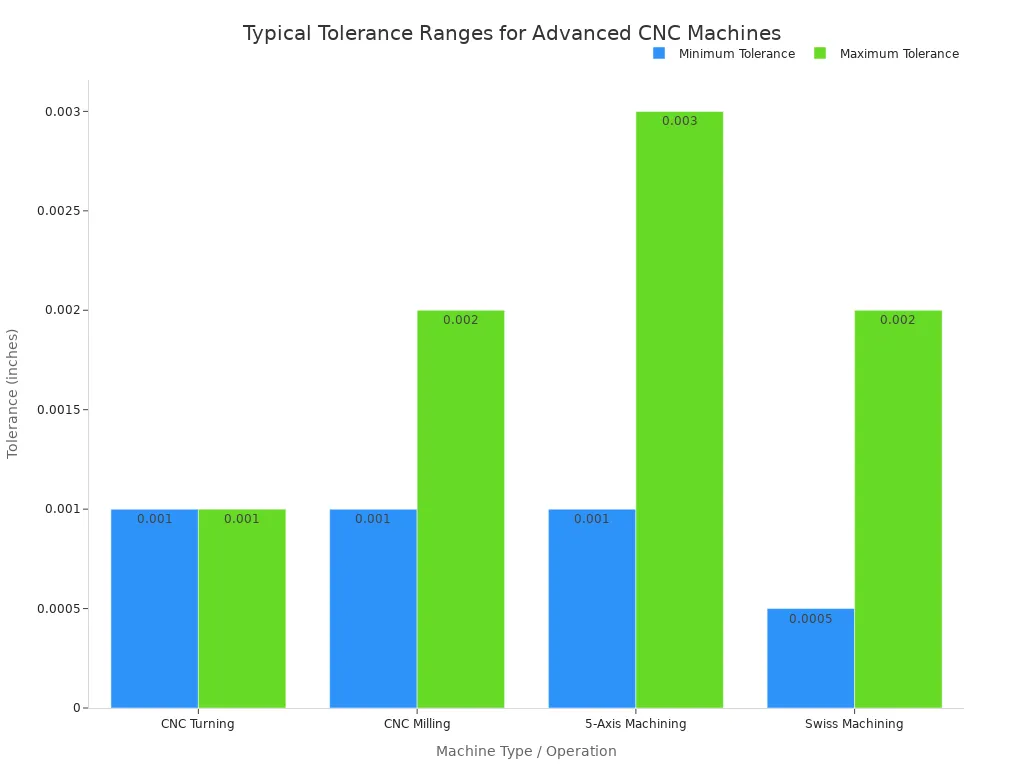
CNC turning at precision level reaches ±0.025 mm. CNC milling at precision level reaches ±0.025–0.051 mm. 5-axis machining achieves ±0.025–0.076 mm. Swiss machining can reach ±0.013–0.051 mm. These numbers show what professional cnc machining service providers can deliver.
You should ask potential suppliers about their machine park. Do they have 3-axis, 4-axis, or 5-axis machines? Each configuration offers different capabilities for tight-tolerance applications. A supplier with 5-axis machines can handle complex geometries in fewer setups. This saves cost and improves quality. For example, a turbine blade requires 5-axis machining. A simple bracket works fine with 3-axis. Matching the machine to the part reduces manufacturing cost.
Engineering expertise also matters. The best cnc machining service providers offer Design for Manufacturing feedback. They review your drawings for GD&T callouts. They suggest improvements to reduce cost and improve quality. This collaboration shows their deep understanding of the machining process.
Quality control is non-negotiable for precision parts production. You need a cnc machining company with robust quality management systems. ISO 9001 certification serves as the baseline. This standard ensures consistency and continuous improvement in manufacturing. ISO 9001 covers every step from design to delivery.
For aerospace and defense work, AS9100 certification adds extra requirements. ISO 13485 covers medical device manufacturing. ISO Class 7 cleanroom capability supports sensitive components. These certifications show that a supplier takes quality seriously.
In-house inspection tools are essential. Coordinate measuring machines (CMMs) verify dimensional tolerances. You should ask for calibration certificates and sample inspection reports. A professional cnc machining company will provide these documents.
A professional CNC machining company should hold ISO 9001 certification. For aerospace and defense work, AS9100 certification adds extra requirements. ISO 13485 covers medical device manufacturing. ISO Class 7 cleanroom capability supports sensitive components. These certifications show that a supplier takes quality seriously.
You should always verify a supplier's certifications. Ask for their current certificates. Check the scope of their certification. Does it cover your specific industry? This step protects your project and your reputation. ISO standards provide a framework for consistent quality.
Quality control also includes in-process inspection. The best cnc machining service providers check parts during production, not just at the end. This catches issues early and reduces waste. It also ensures that your custom cnc machined parts meet specifications every time. This approach reduces cost by preventing rework.
Buying CNC machining in China saves you real money. You can cut costs compared to Western shops. Lower wages, cheaper materials, and a strong supply chain create these savings. Chinese suppliers also accept smaller profits, so you keep more of the savings. Modern machines are easy to find there too. Many factories spend heavily on new CNC tools and measuring devices. Still, you must balance these gains against some risks. Uneven quality, language barriers, and worries about design theft are the biggest ones. A careful review separates good partners from bad ones.
Good engineering decides whether your precision parts turn out right. A skilled team checks your drawings before they cut anything. This Design for Manufacturing (DFM) review finds problems early. For buyers, DFM makes quotes more accurate and lowers supplier risk. For production staff, it improves readiness and cuts troubleshooting. For quality managers, it boosts repeatability and speeds up inspection. For project leaders, it lowers schedule risk and prevents delays.
A close look at geometric dimensioning and tolerancing callouts matters a lot. Unclear inspection results cause poor repeatability and more scrap. A proper review makes sure datums match how the part sits and works. Choosing stable features that reflect real use is key. Misreading material condition modifiers raises costs. A smart engineer spots where MMC for fastener patterns or LMC for thin walls helps. This allows bonus tolerance to widen allowable variation without hurting fit. Over-constraining parts with extra datums makes machining harder. Removing those datums simplifies both cutting and checking.
A skilled supplier shows this engineering skill. Their team reviews GD&T callouts and suggests fixes before production starts. They prove deep knowledge of machining through helpful feedback. This method cuts cost and boosts quality at the same time. When you check a supplier, ask for a sample DFM review. Send them a drawing and see what they say. The quality of their answer shows their true skill.
Language barriers are a common headache when working with CNC machining in China. You need a partner with dedicated English-speaking project managers. These experts translate technical needs correctly. They connect your engineering team with their factory floor. Look for suppliers who give you one main contact for your project. This person should know machining terms, quality control, and inspection steps.
Protecting your designs needs equal focus. Your drawings are valuable assets. You must guard them through the whole sourcing process. Start with a Non-Disclosure Agreement before sharing any drawings. Use secure file transfer methods for all exchanges. Share only the CAD files needed for production. Add confidentiality terms to your purchase order. Clarify tooling ownership in your contracts. A professional CNC machining company will accept these protections. They know that protecting your IP builds long-term trust.
Risk control goes beyond communication and IP. Assembly misalignment from tolerance stack-up needs CMM reports and DFM feedback. Thread seizure after anodizing requires pre-plating size compensation. Thin-wall deformation demands DFM review. Surface finish issues need a supplier with proven experience in your material. Ask for First Article Inspection reports and CPK data to confirm steady tolerances. Verify the quoting party is the actual machining party through video factory inspection. Request batch production records and SPC data for quality consistency.
Coordinate measuring machines check dimensional accuracy across all materials. CMM provides high accuracy and repeatability. This inspection ability ensures your parts meet specs every time. A supplier with in-house CMM equipment and documented inspection steps provides the quality assurance you need.
You need proof that a supplier can handle your specific parts. Ask for case studies from industries similar to yours. A supplier may serve industries such as aerospace, medical, automotive, and electronics. This range shows they understand different tolerance demands.
Look for documented projects that match your challenges. A strong case study shows the problem, the solution, and the measurable outcome. These examples prove real capability. They show how a supplier solves material stability, tolerance, and process-risk challenges. When you review case studies, check for repeatability data and inspection reports. Ask for references you can contact directly.
Project | Challenge | Solution | Outcome |
|---|---|---|---|
Aerospace component | Material warping, tight tolerances | Multi-axis machining with custom fixtures | Met all specifications |
Semiconductor component | Tight flatness and parallelism requirements | Precision machining with advanced setup | Achieved required tolerances |
A reliable partner gives you accurate production timelines. They stay transparent about inspection and shipping processes. You should ask for a detailed schedule that covers material procurement, machining, inspection, and delivery.
A supplier may offer value-added services like deburring and anodizing. These services streamline your supply chain because you avoid sending parts to multiple vendors. One supplier handles everything from raw material to finished surface treatment.
Communication delays can derail your schedule. Use straightforward language in emails and messaging apps. Avoid slang and complex phrases. Use video calls to visually review parts or samples for faster resolution. Always confirm specifications, tolerances, revisions, and approvals in written form. This creates a clear reference for both sides.
Poor communication or slow responses, or lack of attention to technical questions, could lead to production problems.
You should also verify their escalation process. Ask how they handle delays. A professional supplier has a clear plan for different delay lengths. They record issues, adjust schedules, and perform root cause analysis when problems extend beyond a few days.
Delay Type | Initial Contact | Escalation (if unresolved) | Action |
|---|---|---|---|
Short delay | Project Manager | None | Record issue and adjust schedule |
Medium delay | Project Manager | Engineering Manager | Root cause analysis and recovery plan |
Long delay | Engineering Manager | Senior Management | Reprioritize production, consider expedited shipping |
You now have a clear checklist for picking a CNC machining partner. Good machines, strong quality checks, skilled engineers, and clear talks are the base. The lowest price often means trouble for tight-tolerance work. Trust your gut and check claims with sample parts.
Ask for a quote and a sample part to test them. Ask about their machining lead times and shipping choices. Express courier offers fast transit. Sea freight takes longer. A professional supplier offers extras like deburring and anodizing to make your supply chain smoother.
Contact Hehua Machinery Technology to see precision manufacturing done right.
A top-tier cnc machining company guarantees tolerances of ±0.005 mm or better. CNC turning holds ±0.025 mm, and CNC milling achieves ±0.025–0.051 mm. Always ask for documented capability, inspection reports, and manufacturing records.
Ask for ISO 9001 certification and in-house inspection reports. A reliable cnc machining partner for tight-tolerance parts uses CMMs for dimensional checks. Request calibration certificates and sample data.
ISO 9001 is the baseline for quality management. AS9100 covers aerospace components. ISO 13485 covers medical device manufacturing. ITAR supports defense contracts. NADCAP covers advanced aerospace processes. ISO Class 7 cleanroom capability supports sensitive components. A certified cnc machining supplier ensures precision and consistent production quality through thorough inspection.
Design for Manufacturing review catches issues before production starts. Engineers suggest changes to GD&T callouts and material choices. This reduces scrap and shortens lead times. This collaboration improves the design and machining process.
Sign a Non-Disclosure Agreement before sharing drawings. Use secure file transfer methods. Share only the CAD files needed for machining production. A professional supplier accepts these terms. This protects your parts during cnc machining and controls cost.


 AddressNo. 66 Xingpu Road, Lujia Town,Kunshan City, Factory Buildings 3 and 4
  en
en
 English
 繁体中文
繁体中文 Italian
 Spanish
 Japanese
 Portuguese
 Korean
 Russian
 French
 German
 Estonian
 Arabic
 Indonesian


 Message