Galvanized steel is widely used in industrial enclosures, equipment cabinets, mounting brackets, and outdoor protective housings because its zinc coating helps resist corrosion. However, cutting galvanized sheets requires more attention than simply achieving the correct dimensions. Heat can affect the coating near the cut edge, burrs may interfere with assembly, and inconsistent cutting conditions can lead to visible defects or additional finishing work.
For manufacturers sourcing custom sheet metal components, these issues can affect production efficiency, assembly accuracy, and the long-term performance of finished parts. Maintaining consistent edge quality starts with understanding how galvanized steel behaves during cutting and continues through material selection, process adjustment, inspection, and surface treatment.
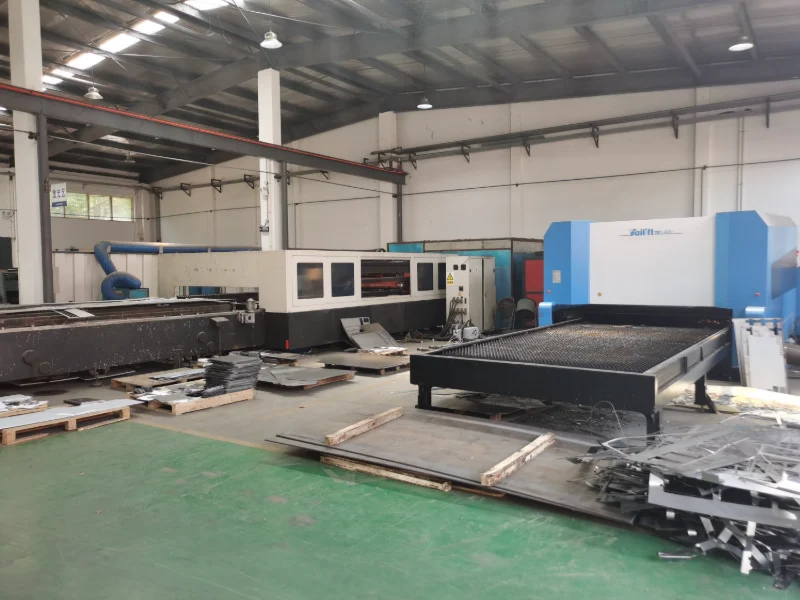
Galvanized steel typically consists of a steel substrate protected by a zinc coating. The coating acts as a barrier against moisture and can provide additional protection around small areas of exposed steel. During laser cutting, however, the concentrated heat melts and separates the material while locally affecting the zinc layer.
Several defects can occur when the cutting process is not properly controlled. Excessive heat input may cause coating discoloration or damage near the edge. Incorrect cutting parameters can leave dross, burrs, or rough surfaces on the underside of the sheet. Inconsistent material positioning and sheet flatness can also affect dimensional accuracy and edge consistency.
These problems become particularly important when the cut components will be bent, welded, coated, or assembled into an enclosure. For example, a mounting bracket with excessive burrs may not sit flush against its mating surface. A cabinet panel with inconsistent edges may require additional manual deburring before bending or assembly.
Using professional Laser Cutting services helps manufacturers manage these process variables and produce components that are easier to integrate into the next production stage.
Material selection is an important first step in controlling edge quality. Galvanized steel grades such as SGCC and SECC are commonly used for equipment housings, electrical cabinets, and protective sheet metal structures. Their coating characteristics and substrate properties can influence cutting behavior, so material specifications should be confirmed before production begins.
Sheet thickness also affects the cutting process. Thin sheets are more sensitive to excessive heat input and may experience local distortion if the cutting sequence is poorly planned. Thicker sheets generally require different combinations of laser power, cutting speed, focus position, and assist gas conditions to achieve a clean separation.
The appropriate settings depend on the actual material, coating condition, equipment capability, and required edge finish. A parameter set that works well for one galvanized sheet may not produce the same result on another material batch.
Before placing a production order, buyers should provide the material grade, nominal thickness, dimensional tolerances, and any special requirements for exposed edges. Where appearance or corrosion resistance is critical, it is also useful to identify which surfaces will remain visible and which areas will receive additional treatment.
At Hehua Machinery Technology (Kunshan) Co., Ltd., sheet metal processing covers galvanized steel, cold-rolled steel, stainless steel, and aluminum sheets, with supported sheet thicknesses ranging from 0.5 mm to 12 mm. Confirming material specifications at the quotation stage helps engineers evaluate the manufacturing route before production starts.
A clean laser-cut edge depends on several interacting parameters rather than a single machine setting. Laser power, cutting speed, focal position, assist gas pressure, and nozzle condition all influence the way material is removed.
Laser power and cutting speed: Excessive heat input can enlarge the heat-affected area and increase the risk of coating damage. Cutting too quickly, on the other hand, may prevent complete penetration and leave rough edges or attached material. The objective is to establish a stable cutting window for the specific sheet thickness and material condition.
Focus position: The focal position influences energy concentration and the shape of the cut kerf. Incorrect focusing can produce uneven edges, excessive dross, or inconsistent cutting performance across the sheet.
Assist gas and nozzle condition: Gas flow helps remove molten material from the cutting zone. Contamination, nozzle damage, or unsuitable gas settings can interfere with this process and contribute to burr formation. Regular inspection and maintenance help keep cutting performance consistent.
Cutting sequence: The order and spacing of cuts can affect heat accumulation and sheet movement. When processing panels with numerous openings or closely spaced features, a suitable cutting sequence helps reduce local overheating and dimensional variation.
Operators should validate these settings through trial cuts when a material or thickness changes. Instead of judging quality only by whether the part separates successfully, they should examine edge smoothness, dross, coating condition, dimensional accuracy, and repeatability across multiple pieces.
Even when the cutting path is accurate, the resulting edge may still need attention. Burrs are unwanted projections along the cut boundary, while dross refers to resolidified material attached to the edge or underside. Both can affect downstream operations.
For components that will be bent, welded, or mechanically assembled, excessive burrs can create fit-up problems and increase handling risks. Deburring and edge finishing should therefore be included in the manufacturing plan rather than treated as an afterthought.
Coating damage requires a different approach. Because laser cutting exposes the steel substrate along the cut line, the edge does not retain the same continuous zinc protection as the original sheet surface. The extent of surrounding coating damage depends on the material and process conditions.
The appropriate finishing method depends on the component's operating environment and design requirements. Some indoor equipment housings may receive powder coating after fabrication. Outdoor components may require a more carefully specified corrosion-protection system. Where a part will be painted or coated, the cut edges should be assessed as part of the complete finishing process.
For example, an outdoor equipment cabinet used in a humid environment may require both controlled cutting quality and a verified post-processing procedure. A clean edge alone does not guarantee long-term corrosion resistance; material selection, edge preparation, coating coverage, and service conditions must be considered together.
Edge quality cannot be evaluated in isolation from the rest of the manufacturing process. A sheet metal part that looks acceptable immediately after cutting may still cause problems during bending, welding, or final assembly.
When a component includes multiple bends, the cut profile must match the developed drawing. Hole locations, slots, notches, and bend lines need to be coordinated so that features remain correctly positioned after forming. Poorly placed cutouts may create interference, while inaccurate dimensions can affect mounting alignment.
A practical approach is to review the complete part geometry before production. Engineers should check the sheet metal development, bend allowances, hole-to-bend distances, assembly clearances, and any features that could create deformation during forming.
For parts with tight dimensional requirements, first-article inspection provides an opportunity to identify problems before they affect a full production batch. Measurements should cover critical dimensions and feature positions, while visual inspection should check burrs, scratches, distortion, and other defects that may affect the finished product.
An integrated manufacturing process also reduces the risk of quality gaps between suppliers. When cutting, bending, riveting, welding, and finishing are coordinated under one production plan, the team can address issues at the stage where they originate rather than correcting them after assembly.
This is particularly useful for industrial cabinets, compressor enclosures, precision instrument housings, and new energy equipment structures that contain multiple sheet metal components.
A consistent inspection plan should define what an acceptable edge looks like and how compliance will be verified. Without clear criteria, different operators may judge the same part differently, leading to inconsistent acceptance decisions.
The inspection plan should include the following checks:
l Dimensional inspection: Verify overall dimensions, hole positions, slots, and other drawing-critical features.
l Edge condition: Check for burrs, excessive dross, incomplete cuts, and irregular contours.
l Coating condition: Examine discoloration, peeling, or visible damage around cut edges where coating integrity matters.
l Flatness and distortion: Confirm that thin panels remain suitable for subsequent forming and assembly.
l Batch consistency: Inspect representative parts throughout production to identify changes in cutting quality.
The required inspection frequency should reflect the component's complexity, production volume, and application risk. A simple internal bracket may need different acceptance criteria from a visible cabinet panel or an outdoor protective housing.
Manufacturers should also retain material records and inspection results when traceability is required. These records help identify whether a recurring issue originates from incoming material, cutting parameters, machine condition, or downstream handling.
At Hehua, quality management is supported by ISO 9001 certification, incoming material checks, first-article inspection, in-process controls, and final inspection. For projects with specific documentation requirements, buyers should confirm the applicable inspection scope and reports before production.
When evaluating a supplier for galvanized steel laser cutting, purchasing teams should look beyond machine availability. Process integration, engineering support, inspection capability, and finishing coordination all influence the quality of the delivered component.
A capable supplier should be able to review drawings, identify manufacturing risks, recommend suitable processing methods, and explain how critical dimensions and edge conditions will be controlled. It should also clarify which finishing operations are available and whether inspection documentation can be provided.
Lead time and production flexibility matter as well. Prototype parts allow buyers to verify fit, appearance, and assembly requirements before approving a larger batch. Once the design is confirmed, a coordinated production process helps maintain consistency across repeat orders.
Hehua Machinery Technology (Kunshan) Co., Ltd. provides sheet metal fabrication and precision metal component manufacturing for industries including industrial machinery, automotive, rail transit, aerospace, wind power, and new energy equipment. Its capabilities include fiber laser cutting, CNC bending, punching, welding, riveting, deburring, and a range of surface treatments.
The company operates a manufacturing facility exceeding 17,800 square meters and employs more than 160 people. Its quality and production systems are supported by ISO 9001, IATF 16949, and EN 15085 certifications, with qualified welding personnel. For custom projects, engineering review and coordination across processing stages can help align the manufacturing plan with drawing requirements and intended application.
When requesting a quotation, provide the latest 2D drawings, available 3D models, material and thickness specifications, annual or batch quantities, required tolerances, and finishing requirements. If the cut edge is especially important, identify the relevant locations on the drawing and state whether additional deburring, coating repair, or corrosion testing is required.
Reliable edge quality in galvanized steel laser cutting comes from controlling the complete manufacturing process. Correct material selection, validated cutting parameters, routine equipment maintenance, suitable edge finishing, and clearly defined inspection criteria all contribute to repeatable results.
For buyers, the most effective way to reduce manufacturing risk is to communicate requirements before production begins and evaluate representative samples against the actual drawing and application. This makes it easier to identify potential problems early, avoid unnecessary rework, and establish a stable process for future orders.
Whether the requirement is a small mounting bracket or a multi-component industrial enclosure, Laser Cutting should be treated as one stage of a coordinated sheet metal fabrication workflow. With appropriate engineering review and quality control, galvanized steel parts can achieve consistent dimensions, cleaner edges, and more predictable downstream performance.



 AddressNo. 66 Xingpu Road, Lujia Town,Kunshan City, Factory Buildings 3 and 4
 en
 English
 繁体中文
 Italian
 Spanish
 Japanese
 Portuguese
 Korean
 Russian
 French
 German
 Estonian
 Arabic
 Indonesian


 Message