Manufacturers today are expected to produce high-quality metal parts faster than ever while maintaining consistent dimensions and minimizing production costs. Whether the application is automotive hardware, compressor accessories, industrial machinery, or pneumatic equipment, achieving both precision and efficiency has become a key competitive advantage.
This is where Progressive Die Stamping stands out. By combining multiple metal forming operations into one continuous process, progressive die stamping enables manufacturers to produce complex sheet metal components with excellent repeatability and high production speed.
Compared with conventional stamping methods that require multiple setups and secondary handling, progressive die stamping streamlines production while maintaining tight tolerances throughout long manufacturing runs. In this article, we'll examine how this process improves both manufacturing precision and production efficiency, and why it has become a preferred solution across many industries.
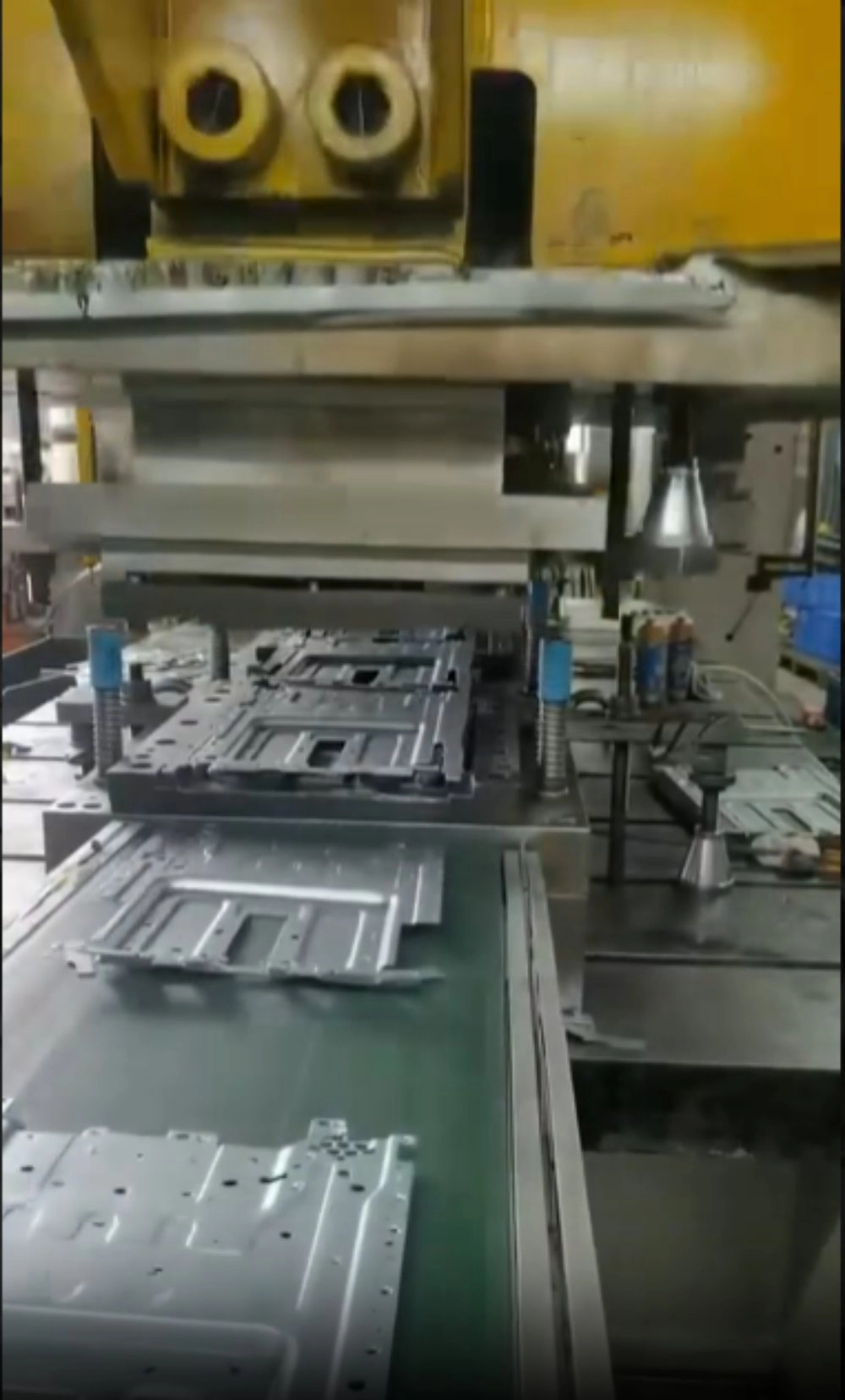
Progressive die stamping is a metal forming process that uses a specially designed die containing multiple workstations. A continuous strip of metal feeds automatically through the die, with each station performing a specific operation such as:
· Blanking
· Punching
· Bending
· Coining
· Embossing
· Forming
After each press stroke, the strip advances to the next station until the finished part is separated from the material.
Because every operation takes place within one automated production cycle, manufacturers can significantly reduce production time while ensuring every part follows the same manufacturing path.
This process is widely used to manufacture:
· Compressor accessories
· Precision brackets
· Pressure shells
· Industrial machinery hardware
· Pneumatic equipment parts
· Precision shims
· Electrical components
· Custom sheet metal parts
For many industrial products, even a small dimensional deviation can affect assembly quality, equipment performance, or product lifespan.
Precision is especially important for industries such as:
· Automotive manufacturing
· Aerospace
· Rail transit
· Semiconductor equipment
· New energy equipment
· Industrial automation
Components that fail to meet specifications may require additional machining, manual adjustment, or complete replacement, increasing production costs and delaying delivery schedules.
Progressive die stamping minimizes these risks through standardized tooling and automated processing.
The foundation of progressive die stamping lies in the accuracy of the tooling.
Each workstation inside the die is engineered to perform a dedicated operation while maintaining precise alignment with the previous step.
Because the tooling remains fixed throughout production, manufacturers achieve highly repeatable results from the first component to the last.
Unlike manual fabrication methods, there is little opportunity for positioning errors between operations.
Manual handling introduces inconsistencies that can affect product quality.
Progressive die stamping uses automatic feeding systems to move material through each workstation with consistent positioning.
This provides several important benefits:
· Stable part location
· Uniform forming sequence
· Consistent punch alignment
· Reduced operator influence
Automation not only improves accuracy but also supports continuous production with minimal interruption.
For OEM manufacturers, dimensional consistency is often more important than production speed.
Professional progressive die stamping suppliers are capable of achieving:
· Stamping tolerances of ±0.008 mm to ±0.03 mm
· Flatness of ≤0.02 mm
· Deep drawing wall thickness deviation within 5%
These capabilities allow manufacturers to produce parts suitable for demanding assembly environments where every dimension matters.
Typical products benefiting from this level of precision include:
· Precision brackets
· Pressure shells
· Compressor components
· Special-shaped metal parts
· Mechanical supports
Precision manufacturing depends on more than accurate tooling—it also requires rigorous inspection.
Professional manufacturers typically implement multiple quality control stages, including:
· Incoming material inspection
· First article inspection
· In-process quality monitoring
· Coordinate Measuring Machine (CMM) inspection
· 100% inspection of key dimensions
· Complete inspection reports
Material spectrum testing and full production traceability further help ensure that every batch meets customer specifications.
While precision is essential, manufacturers must also meet increasingly demanding delivery schedules.
Progressive die stamping improves efficiency in several important ways.
Traditional fabrication often requires several separate machines for cutting, punching, bending, and forming.
Each additional process increases:
· Setup time
· Material handling
· Labor requirements
· Production complexity
Progressive die stamping combines these operations into one automated production sequence.
Instead of moving workpieces between multiple stations, the material advances continuously through one precision die, dramatically increasing throughput while reducing production time.
Progressive die stamping is particularly well suited for large production runs.
Once the tooling has been completed and validated, production can continue with minimal interruption.
This makes the process ideal for:
· Annual production programs
· Global export orders
· Long-term OEM contracts
· Continuous manufacturing
Manufacturers operating automatic stamping lines with 63T–315T precision presses can maintain stable output while ensuring consistent product quality across large
One advantage of progressive die stamping is that many finished parts require little or no additional processing after stamping.
Depending on the product design, operations completed during the stamping process may include:
· Hole punching
· Edge trimming
· Bending
· Embossing
· Forming
For more complex components, progressive stamping can also be combined with deep drawing stamping to manufacture shell-shaped or pressure-resistant parts efficiently.
Reducing secondary operations shortens production cycles and lowers overall manufacturing complexity.
Raw materials represent a significant portion of manufacturing costs.
Progressive die tooling is carefully designed to maximize material utilization by optimizing strip layouts and minimizing scrap.
Manufacturers commonly process:
· Cold rolled steel
· Carbon steel
· Galvanized steel
· 304 stainless steel
· 316 stainless steel
· Aluminum
· Copper
· Special deep drawing steel
Efficient material usage not only reduces waste but also supports more sustainable manufacturing practices.
Efficient manufacturing starts long before the first sheet of metal enters a stamping press. Product design, tooling development, and process planning all influence the final production result.
An experienced progressive die stamping supplier provides engineering support during the early stages of a project to help customers avoid unnecessary production risks.
Typical engineering services include:
· DFM (Design for Manufacturability) analysis
· Tooling feasibility evaluation
· Material selection recommendations
· Drawing optimization
· Cost reduction suggestions
· Prototype verification
Manufacturers that support 2D CAD drawings, 3D STEP, IGS, SolidWorks, and reverse engineering from physical samples can help customers move efficiently from product concept to mass production.
For companies developing new products or replacing imported components, early engineering involvement often shortens development cycles and reduces manufacturing costs without compromising product performance.
Many OEM projects involve more than stamping alone. After metal parts are formed, additional processes such as machining, welding, and surface finishing are often required before assembly.
Working with multiple suppliers can increase lead times, create communication challenges, and complicate quality management.
A one-stop manufacturing solution simplifies this process by integrating multiple capabilities under one roof.
Typical services include:
· Mold design and manufacturing
· Progressive die stamping
· Deep drawing stamping
· Precision punching
· Thick plate forming
· CNC machining
· Welding and assembly
· Surface treatment
· Dimensional inspection
· Export packaging
Instead of coordinating several production partners, customers work with a single engineering team responsible for the entire manufacturing process. This approach improves project coordination, reduces production delays, and ensures consistent quality throughout the supply chain.
Not every metal component can be produced through conventional stamping alone.
Products such as pressure shells, cylindrical housings, and deep structural components often require additional forming operations.
By combining progressive die stamping with deep drawing stamping, manufacturers can produce parts featuring:
· Uniform wall thickness
· Stable structural strength
· Smooth surface quality
· Excellent dimensional consistency
Typical applications include:
· Compressor shells
· Pressure housings
· Mechanical covers
· Industrial containers
· Pneumatic equipment components
With wall thickness deviation controlled within 5%, deep drawing technology complements progressive die stamping for more complex industrial applications.
As production volumes increase, manufacturers need suppliers that can maintain consistent output without sacrificing quality.
Professional progressive die stamping manufacturers invest in modern equipment to support stable production.
Typical production capabilities include:
· Precision presses from 63T to 315T
· Automatic stamping production lines
· In-house mold workshop
· Flexible production scheduling
· Small trial orders
· Annual bulk production
· Global export capability
Owning tooling workshops also enables faster mold maintenance, engineering modifications, and shorter lead times for repeat orders.
For OEM customers, these capabilities translate into better production planning and more dependable delivery performance.
The combination of accuracy, speed, and repeatability makes progressive die stamping suitable for a wide variety of industries.
Common applications include:
Battery brackets, reinforcement plates, connectors, seat components, and structural hardware.
Equipment brackets, mounting plates, support frames, protective covers, and precision mechanical parts.
Compressor accessories, pressure shells, support brackets, valve components, and housings.
Cylinder brackets, valve supports, air system hardware, and precision mounting components.
Equipment supports, cable management hardware, and structural sheet metal assemblies.
Precision brackets, lightweight structural components, and equipment mounting hardware.
Equipment racks, sensor brackets, enclosure components, and precision support structures.
Battery system components, electrical supports, cooling system brackets, and structural reinforcements.
Across all these industries, manufacturers share the same priorities: consistent quality, repeatable precision, and dependable delivery. Progressive die stamping helps meet these requirements through automated production and standardized tooling.
Choosing the right manufacturing partner is just as important as selecting the right production process.
Established in 2005, Shanghai Hehua Machinery Technology Co., Ltd. and its subsidiary Hehua Machinery Technology (Kunshan) Co., Ltd., founded in 2018, specialize in manufacturing key metal parts for high-end industries including automotive, rail transit, aerospace, wind power, nuclear power, industrial machinery, semiconductor equipment, and new energy equipment.
Operating from a manufacturing facility covering more than 17,800 square meters with over 160 employees, Hehua provides comprehensive OEM and ODM services that include:
· In-house mold development
· Progressive die stamping
· Deep drawing stamping
· CNC machining
· Welding
· Complete surface treatment
· Final quality inspection
Customers also benefit from:
· 7-day fast sampling
· Dedicated account management
· One-on-one engineering support
· DFM optimization
· Material traceability
· Full inspection reports
· Export-ready packaging
· A 98% on-time delivery rate
The company's quality management system is backed by internationally recognized certifications, including ISO 9001, IATF 16949, EN 15085, and EN 9606-1, demonstrating its commitment to delivering precision metal components for demanding industrial applications.
Precision and production efficiency are no longer competing objectives. With modern manufacturing technologies, companies can achieve both by selecting the right production process and the right manufacturing partner.
Progressive Die Stamping improves manufacturing performance by combining multiple forming operations into one continuous production cycle. The result is tighter dimensional control, faster production, improved material utilization, and greater consistency across high-volume manufacturing programs.
When combined with engineering support, in-house tooling, deep drawing capabilities, CNC machining, welding, and complete quality management, progressive die stamping becomes a comprehensive solution for producing complex metal components across a wide range of industries.
Whether your project involves compressor accessories, industrial machinery, pneumatic equipment, or custom precision sheet metal parts, partnering with an experienced manufacturer helps ensure reliable quality from prototype development to full-scale production.


 AddressNo. 66 Xingpu Road, Lujia Town,Kunshan City, Factory Buildings 3 and 4
  en
en
 English
 繁体中文
繁体中文 Italian
 Spanish
 Japanese
 Portuguese
 Korean
 Russian
 French
 German
 Estonian
 Arabic
 Indonesian


 Message