Choosing the right bending process is a critical step when developing custom metal components. In sheet metal fabrication, bending directly affects the final structure, dimensional accuracy, assembly performance, and overall product reliability. Whether you are manufacturing industrial equipment cabinets, protective housings, precision brackets, or new energy equipment enclosures, selecting the appropriate Bending solution can significantly improve product quality and production efficiency.
However, not every bending process is suitable for every project. Material type, sheet thickness, component complexity, production volume, tolerance requirements, and surface finishing needs all influence the final manufacturing method.
Shanghai Hehua Machinery Technology Co., Ltd. provides comprehensive sheet metal fabrication solutions, including laser cutting, CNC bending, welding, riveting, assembly, and surface treatment. With advanced manufacturing capabilities and engineering expertise, Hehua helps customers select the most suitable bending process for prototype development, small-batch production, and large-scale manufacturing.
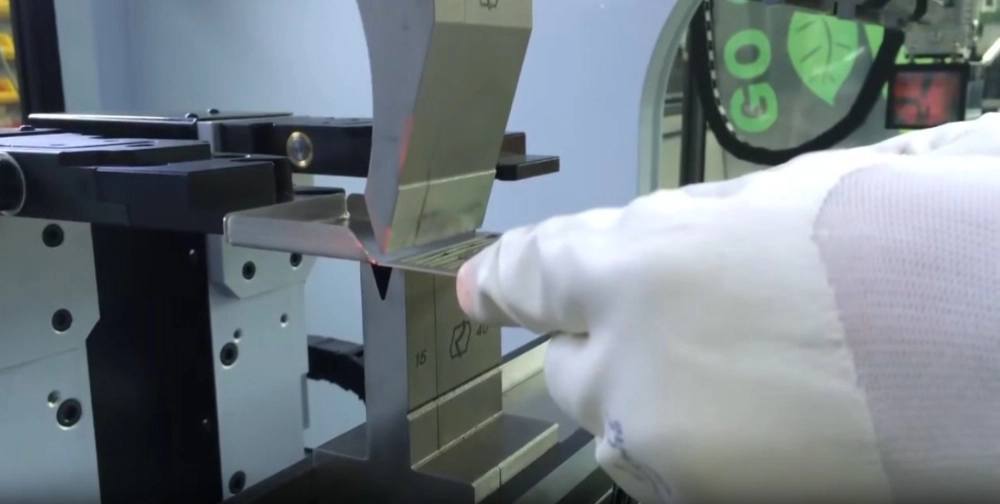
Bending is a metal forming process that changes the shape of a flat sheet into a three-dimensional structure without removing material. It is widely used because it provides strong mechanical performance while maintaining material efficiency.
Compared with machining processes that remove large amounts of material, bending offers advantages such as:
· Reduced material waste
· Improved structural strength
· Faster production cycles
· Better consistency for mass production
· Lower complexity for sheet metal structures
In modern manufacturing, bending is usually combined with other processes, including laser cutting, punching, welding, and surface treatment, to create complete sheet metal components.
Selecting the correct bending method requires a detailed evaluation of your product requirements.
The following factors should be considered:
Different metals have different characteristics, including hardness, flexibility, and springback behavior.
Common sheet metal materials include:
· Cold rolled steel (SPCC)
· Galvanized steel (SGCC/SECC)
· Stainless steel 304 and 316
· Aluminum alloy sheet
· Copper sheet
· Electrolytic plate
· Galvalume steel sheet
For example, stainless steel is often selected for corrosion-resistant equipment enclosures, while aluminum is preferred for lightweight structures. Copper sheets may be used for conductive components such as busbars.
A professional manufacturer evaluates material properties before selecting tooling and bending parameters.
Sheet thickness directly affects bending force requirements and process selection.
Hehua supports sheet thicknesses from 0.5mm to 12mm, covering applications from thin precision panels to heavy-duty structural components.
Thin sheets require careful control to prevent:
· Surface marks
· Deformation
· Cracking
· Accuracy issues
Thicker materials require stronger equipment and optimized forming processes to achieve stable results.
Simple parts and complex structures require different approaches.
Simple bending applications may include:
· Flat brackets
· Covers
· Panels
· Basic supports
More complex components may involve:
· Multiple bending angles
· Special-shaped contours
· Sealed cavities
· Precision equipment frames
· Large structural assemblies
For complicated designs, CNC bending combined with engineering optimization helps prevent interference and forming problems.
For most modern industrial applications, CNC bending has become the preferred solution because of its accuracy and repeatability.
CNC bending equipment uses programmed parameters to control:
· Bending position
· Angle accuracy
· Tool movement
· Processing sequence
This allows manufacturers to produce consistent parts even for complex designs or large production volumes.
Advantages of CNC bending include:
Precision sheet metal components often require strict dimensional control.
Hehua's CNC bending capabilities achieve:
· Dimension tolerance of ±0.05~±0.1mm
· Bending angle tolerance within ±0.5°
· Sheet metal forming flatness ≤0.02mm/100mm
These standards are suitable for industries requiring high precision, including automation equipment, semiconductor systems, and new energy equipment.
For manufacturers producing hundreds or thousands of components, consistency is essential.
CNC bending reduces variation between parts by maintaining:
· Repeatable processing parameters
· Stable tooling positions
· Controlled forming sequences
This helps reduce assembly problems and improves production efficiency.
Springback is one of the most common challenges in sheet metal bending.
After bending, metal naturally attempts to return slightly toward its original shape due to internal stress.
If springback is not properly controlled, it can cause:
· Incorrect angles
· Assembly difficulties
· Dimensional deviations
· Increased production waste
Professional manufacturers use engineering analysis and process optimization to compensate for springback.
Hehua provides bending springback analysis and forming optimization solutions to reduce production defects during mass manufacturing.
Different projects may require different bending technologies.
This is one of the most common bending methods for industrial sheet metal fabrication.
Suitable for:
· Equipment housings
· Cabinets
· Structural brackets
· Protective covers
Advantages include high flexibility and suitability for customized production.
Servo-driven bending equipment provides improved control and efficiency.
It is suitable for:
· Precision components
· Complex structures
· High-volume manufacturing
The improved control system helps maintain stable processing quality.
For large-scale production, automated bending systems can improve efficiency.
Benefits include:
· Reduced manual operation
· Higher production consistency
· Faster processing speed
· Better labor efficiency
Hehua has automatic bending robots and flexible sheet metal production lines to support high-efficiency manufacturing.
A reliable bending supplier should provide more than a single process.
A complete fabrication workflow typically includes:
Engineers review drawings to identify:
· Bending interference
· Material selection issues
· Forming risks
· Production optimization opportunities
Precise cutting prepares the sheet metal before bending.
Hehua uses fiber laser cutting technology with dimension tolerance of ±0.03~±0.05mm.
CNC bending forms the required structure with controlled accuracy.
Additional processes such as TIG welding, MIG welding, riveting, and assembly complete the final component.
Various finishing options improve appearance and performance, including:
· Powder coating
· Brushing
· Anodizing
· Polishing
· Galvanizing
· Electrophoresis
· Nickel plating
· Passivation
This one-stop manufacturing approach simplifies supplier management and ensures better process coordination.
Precision bending is widely used across many industries.
Typical applications include:
· Machine cabinets
· Equipment frames
· Protective guards
· Metal housings
· Battery equipment enclosures
· Energy storage cabinets
· Structural supports
· Precision instrument enclosures
· Equipment racks
· Custom metal structures
· Manufacturing equipment parts
· Precision brackets
· Protective components
· Structural metal components
· Equipment protection systems
Founded in 2005, Shanghai Hehua Machinery Technology Co., Ltd. specializes in manufacturing key metal components for high-end equipment industries.
The company serves customers in:
· Automotive
· Rail transit
· Aerospace
· Wind power
· Nuclear power
· Industrial machinery
· Semiconductor equipment
· New energy equipment
Hehua operates a manufacturing facility covering more than 17,800 square meters in Kunshan, Jiangsu Province, with over 160 employees.
Its production capabilities include:
· Fiber laser cutting
· CNC bending
· CNC punching
· Welding
· Assembly
· Surface treatment
The company has obtained internationally recognized certifications, including:
· ISO 9001 quality management certification
· IATF16949 automotive quality certification
· EN 15085 rail welding system certification
· EN 9606-1 welder qualification certification
These certifications demonstrate Hehua's commitment to reliable manufacturing and strict quality control.
Choosing the right bending process is essential for producing reliable custom metal components. Factors such as material selection, thickness, design complexity, accuracy requirements, and production volume all influence the best manufacturing approach.
A professional sheet metal partner can help optimize bending processes, reduce production risks, and improve product performance.
If you need a reliable solution for custom sheet metal fabrication, explore the Bending services from Shanghai Hehua Machinery Technology Co., Ltd. With advanced CNC processing equipment, experienced engineers, and complete manufacturing capabilities, Hehua provides precision bending solutions for demanding industrial applications worldwide.


 AddressNo. 66 Xingpu Road, Lujia Town,Kunshan City, Factory Buildings 3 and 4
  en
en
 English
 繁体中文
繁体中文 Italian
 Spanish
 Japanese
 Portuguese
 Korean
 Russian
 French
 German
 Estonian
 Arabic
 Indonesian


 Message